

Flower Meanings: A Complete Guide to Every Flower's Symbolism
Flower Meanings: A Complete Guide to Every Flower's Symbolism
Flower Meanings: What Every Flower Really Says
UPDATED 1 MAY 2026
Flowers have always done the talking when words feel too small, too clumsy, or too risky. The language of flowers, known as floriography, has been practiced for thousands of years across various cultures in Europe, Asia, and Africa, with many meanings derived from ancient myths, Greek mythology, and the rich history of how humans have always wanted to say more than we can. Flowers have long been a silent language across cultures, used to express complex emotions, honour the divine, and celebrate the cycles of life and death. We have been arranging meaning into stems since the sacred lotus in Ancient Egypt and the orange blossom crowns of Roman brides, all the way through to the Victorian bouquets in London drawing rooms where a man could say I love you, I'm sorry, please write back without ever speaking. We send flowers daily across Cape Town and Johannesburg, and the question we get asked most is simple: what does this one actually mean? This guide answers it. Properly. Every popular flower, every colour, every birth month, the cultural meanings around the world, the Victorian flower language in detail, the South African indigenous flowers nobody else writes about, the wedding bouquet traditions, and the awkward ones you might want to avoid. If you are stuck on what to send, scroll to the flowers for every feeling section. If you just love the romance of it, start at the top.
A Quick History of the Language of Flowers (Floriography)
The language of flowers, known as floriography, exploded in the Victorian era when expressing emotion in plain English was considered impolite, indulgent, or downright scandalous. A red rose meant love. A yellow rose meant friendship, or jealousy, depending on which guidebook your courter owned. A bouquet was a coded letter. A single bloom returned upside down meant the answer was no.
The roots go back further. Ancient Greeks tied roses to Aphrodite. Egyptians wove lotus flowers into mythology and tomb art. Persian gardens carried symbolic meaning in every petal. The Victorians simply organised the chaos into pocket dictionaries, and by the 1850s, choosing the wrong flower could ruin a courtship.
Modern flower meanings still carry that history. When you send a bouquet of flowers today, you are leaning on centuries of agreed code. Most people no longer carry a floriography handbook, but the meanings sit in the cultural memory anyway. A red rose still says one thing. White lilies still say another. Even people who claim not to care can usually feel the difference. Flower symbolism, whether you call it floriography, the Victorian flower language, or the language of flowers, is the shared vocabulary almost every flower-giving culture leans on, and most beautiful blooms can speak it without us having to explain.
The Victorian Flower Language: A Closer Look at Floriography's Golden Age
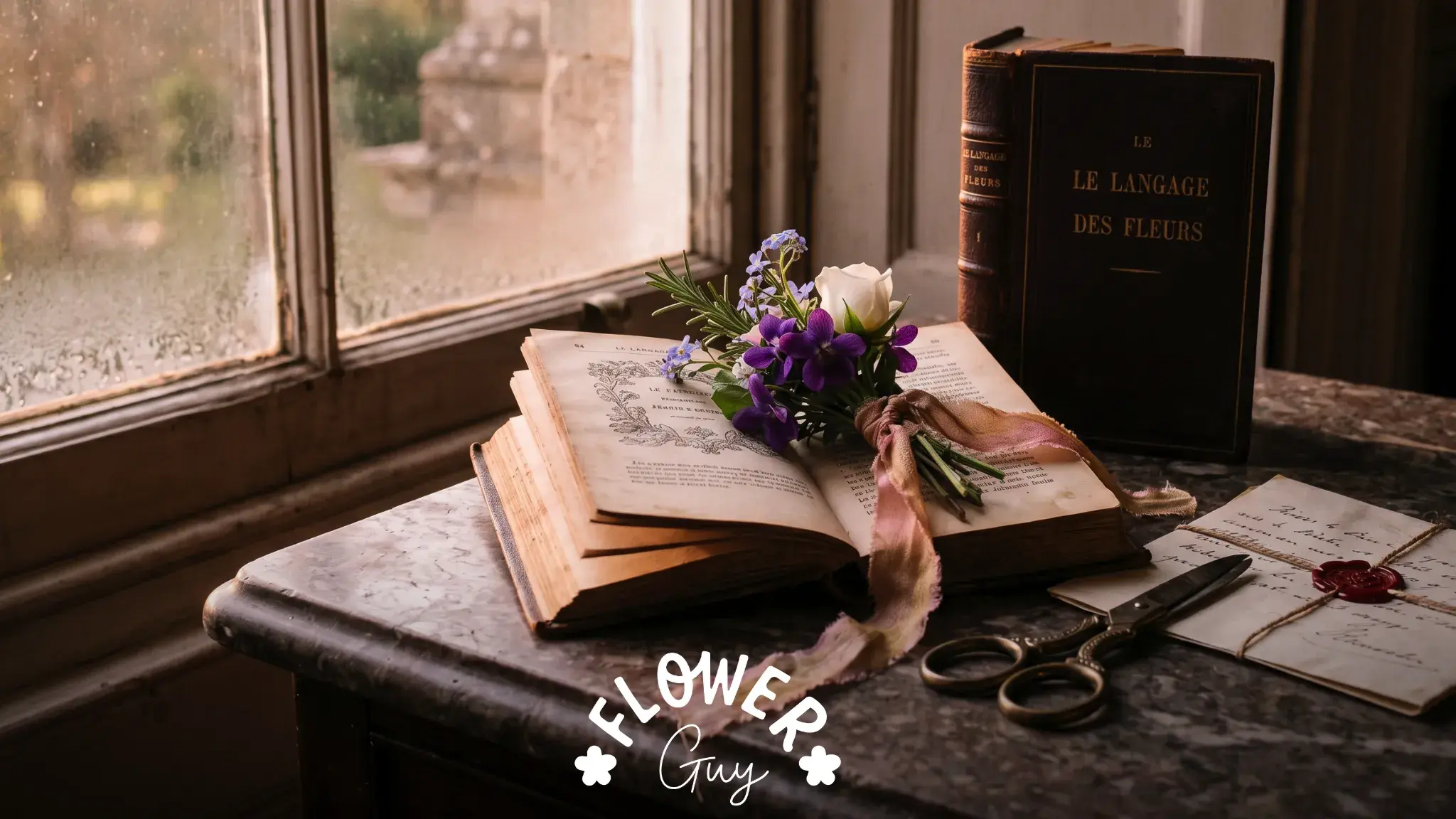
The Victorian era (1837 to 1901) was when the language of flowers, the Victorian flower language proper, reached its peak. Flowers were used to convey messages that could not be spoken aloud, allowing individuals to express feelings and sentiments through floral arrangements when society would have judged them harshly for saying the same things in plain English. It became a popular hobby. Pocket dictionaries called Le Langage des Fleurs and Kate Greenaway's Language of Flowers sold by the cartload, and learning the symbolism of flowers turned into a parlour pastime that crossed the Atlantic and reached as far as the Cape Colony.
The way flowers were presented in the Victorian flower language was significant. For example, handing flowers with the right hand indicated a yes answer, while the left hand indicated no. Tilting the bouquet to the right meant the message applied to the giver. Tilting to the left meant the message applied to the recipient. Even the order of the stems mattered.
Single flowers in the Victorian era often conveyed a straightforward message, while bouquets allowed for a more complex expression of emotions, combining the meanings of different flowers into something closer to a sentence than a single word. A bouquet of red tulips, white lilies and forget-me-nots was an entire confession.
The condition of the bloom mattered too. Withered flowers reversed the meaning entirely. Sending a wilted bouquet to a courter was a polite but unmistakable end of things. Even the way flowers were tied, ribboned, or wrapped carried meaning. Knowing how to read a Victorian bouquet was a skill that married women were expected to teach their daughters.
This silent dialogue created an entire shadow vocabulary that thrived precisely because it was unsayable out loud. The Victorian language of flowers gave people permission to flirt, to confess, to break things off, to apologise, to grieve, all without ever scandalising their neighbours. We owe the modern meanings of nearly every popular flower to this period. When you choose flowers today, you are still speaking in this code, even if you do not know the rules. The Victorians turned the most beautiful blooms of the season into a private language, and we have inherited the vocabulary whether we realise it or not.
Flower Meanings Around the World: Cultural Differences You Need to Know
Flowers hold profound significance worldwide, often used to convey messages in weddings, funerals, religious ceremonies, and seasonal celebrations. In many cultures, flowers symbolise emotions, spiritual beliefs, and cultural milestones, with meanings that can change drastically depending on context. Sending the wrong flower in the wrong country can land somewhere between awkward and offensive, so this section is worth reading before you send flowers internationally.
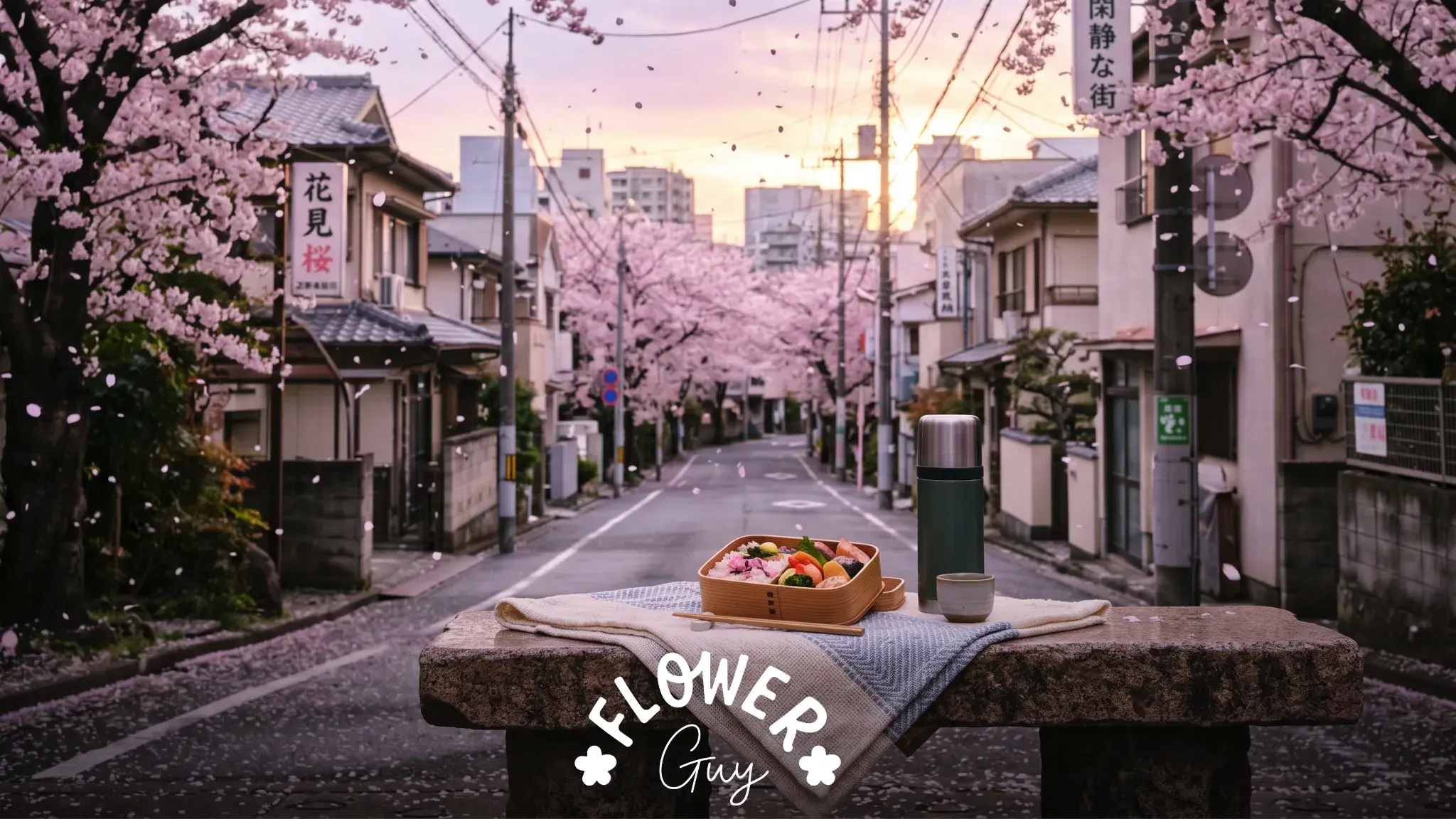
In Japan, hanami is a traditional Japanese custom of flower viewing, where people gather to appreciate blooming cherry trees in spring. Cherry blossoms in Japan represent the transience of life and the fleeting nature of existence. The blooms last only days, then fall, and the entire culture pauses to acknowledge this. Cherry blossoms also signal new beginnings, since they bloom at the start of the school and business year. They are not romantic in the way Western culture treats roses. They are philosophical, almost spiritual.
In China, the chrysanthemum is a Chinese emblem of longevity, autumn, and noble character. It appears constantly in Chinese poetry and painting, and the Double Ninth Festival is celebrated by drinking chrysanthemum tea and writing poems about the flower. Peonies, the Chinese national bloom, mean wealth, honour, and a happy life. The lotus is a Chinese Buddhist symbol of purity rising from muddy water.
In India, the lotus is a sacred symbol in Hinduism and Buddhism, representing the journey of the soul toward spiritual awakening. It grows from murky water and emerges spotless, which is why it became the metaphor for enlightenment. Marigolds are central to Hindu weddings, festivals, and temple offerings. Jasmine carries meanings of love, beauty, and sensuality, and is woven into the hair of brides and dancers.
Hidden meanings in flower symbolism appear most clearly in cultural-specific traditions. In Mexico, marigolds are essential to Day of the Dead celebrations, believed to guide the spirits of the departed with their vibrant colours and musky scent. Families build ofrendas covered in marigolds (cempasúchil) so that loved ones can find their way home for the celebration. The same flower that reads as cheerful and warm in South Africa carries this profound spiritual weight in Mexico.
In Greek mythology, almost every flower has a story. Roses sprang from the blood of Adonis. Narcissus fell in love with his own reflection and turned into the daffodil. Hyacinth grew from the blood of a young man accidentally killed by Apollo. Iris, the messenger of the gods, gave her name to the flower whose colours mirror the rainbow she carried. Anemones grew from the tears of Aphrodite. The Greek roots of floriography sit underneath almost every meaning we still use today.
In Christian symbolism, the white lily is the flower of the Virgin Mary, attached to her purity and her assumption into heaven. White roses, white lilies, and orange blossom appear constantly in Christian wedding tradition for the same reason. The orange blossom in particular became the bridal flower across Europe, North Africa, and the Mediterranean, where it carries meanings of fertility, eternal love, and a happy life.
Chrysanthemums symbolise longevity and rejuvenation in many Asian cultures, while in some European countries (notably France, Italy, Belgium, Poland) they are associated with death and used only for funerals. This is the most common cultural mistake South Africans make when sending flowers abroad. Do not send chrysanthemums to a French boyfriend's mother for her birthday. Send roses.
In South Africa, our indigenous flower meanings sit at the intersection of multiple cultural traditions: Khoisan plant lore, Xhosa and Zulu symbolism, Cape Dutch garden tradition, and modern Commonwealth floriography. We cover the South African flowers in detail in their own section below, because they deserve more than a paragraph.
How Flower Meanings Actually Work
Flower meanings come from four overlapping sources, and once you know them, you can decode almost any bouquet on instinct.
The first is colour. Red flowers almost always carry romance, passion, or strong feeling. White flowers signal purity, peace, or sympathy. Yellow flowers tend toward friendship, joy, and cheerfulness. We cover the full breakdown in the flower colour meanings section below.
The second is shape and species. A rose carries different meaning to a tulip. A lily carries different meaning to a sunflower. The bloom itself has a story attached, often inherited from mythology, religion, or Victorian convention.
The third is cultural context. Chrysanthemums are joyful in the United States but funerary in much of Europe. White flowers say purity at a Western wedding and mourning at a traditional Chinese funeral. South African indigenous flowers like protea carry distinctly local meaning that imported guides usually skip.
The fourth is personal context. The flower your gran grew. The bouquet from a first date. The arrangement at a funeral that knocked the air out of you. Personal history beats the dictionary every time.
When you are picking flowers, blend all four. Pick a flower whose general meaning fits, in a colour that strengthens the message, that carries the right cultural weight, and that means something to the person receiving it. That is how you send something that actually lands.
Rose Meanings by Colour: The Most-Asked-About Flower
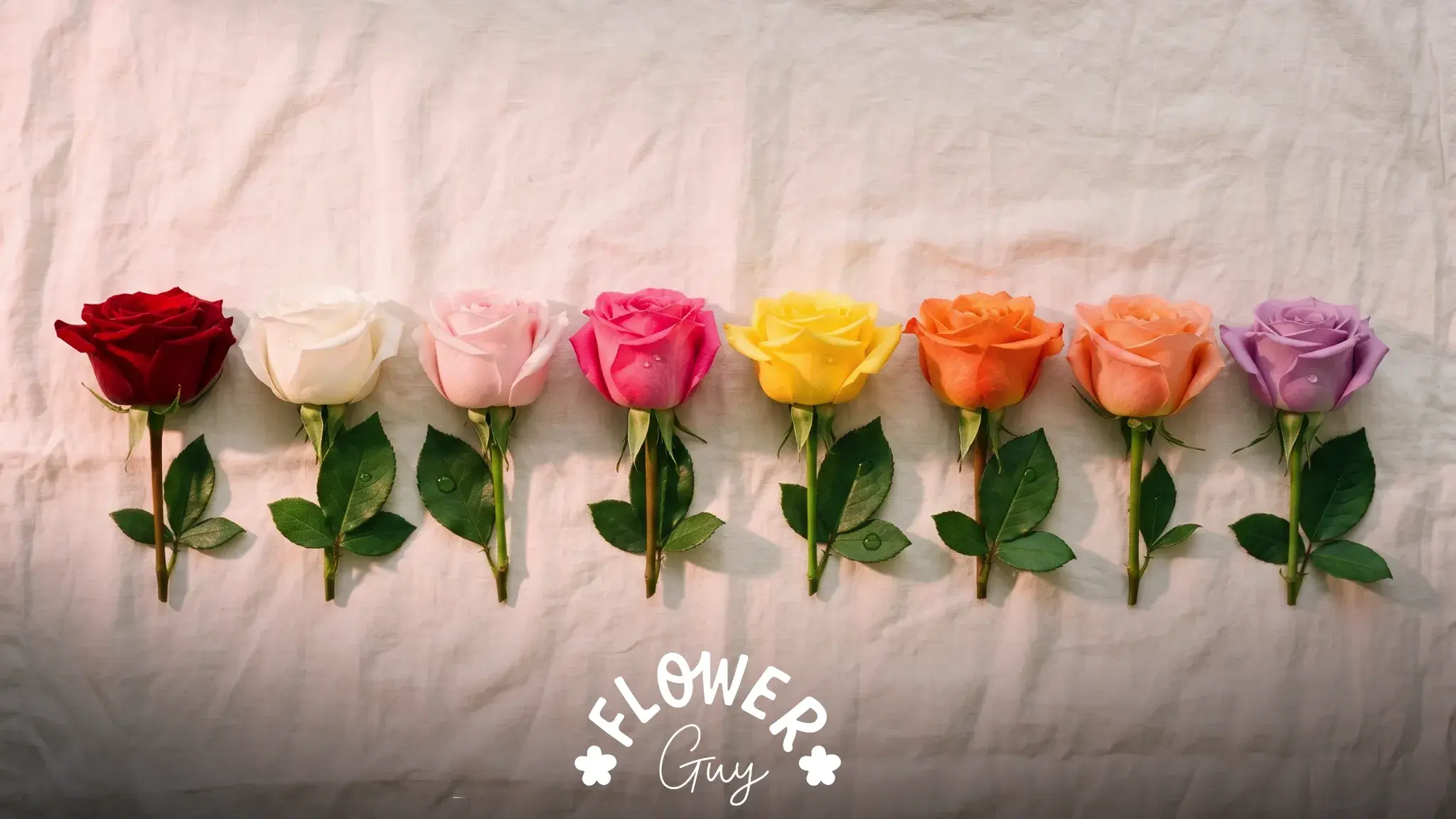
Roses carry more weight than any other flower in the world, which is why rose bouquets are the most-sent gift in South Africa year after year. The colour does almost all the talking.
Red roses mean deep romantic love, passion, and commitment. They are the language of I love you without ambiguity. A single red rose says one thing. A dozen says you mean it. Fifty says you really mean it. Our Romantic Red Roses Bouquet and Red Rose Bouquet collections are built for exactly this moment, and the 50 Roses Bouquet is for when you need to say it loudly.
White roses mean purity, new beginnings, and reverence. They carry beautifully at weddings, christenings, and as a quiet sympathy gesture. Our White Rose Bouquet collection works for any of these moments.
Pink roses mean gratitude, admiration, and gentle affection. They are the thank you flower, the I appreciate you flower, the I think you are wonderful but we are taking it slow flower. Soft pink leans gentler. Hot pink turns up the volume. The Pink Rose Bouquet collection covers both.
Yellow roses mean friendship, joy, and warmth. The Victorians once attached jealousy to yellow roses, but modern usage has shaken that off almost completely. Today they say I'm glad you exist. Send them to friends, to someone going through a rough patch, or to your mom on a random Tuesday.
Orange roses mean enthusiasm, energy, and fascination. They sit somewhere between the friendliness of yellow and the passion of red. Send them when something exciting is happening: a new chapter, a big win, a let's see where this goes.
Peach and coral roses mean sincerity, modesty, and gratitude. They are a softer, more grown-up version of pink. Beautiful for thank-you moments and quiet appreciation.
Lavender or purple roses mean enchantment, love at first sight, and mystery. They are unusual enough to feel intentional. Send them when you want to say you are not like anyone else I have met. Lavender roses are a gorgeous flower for a recipient who notices unusual choices, and a beautiful flower for someone with a strong sense of personal taste.
A mix of red and white roses means unity, harmony, and a love that has seen things. It is the bouquet for an anniversary that means something. The Mixed Flower Bouquet collection includes options that lean this way.
Tulip Meanings: A Love Letter Without Words
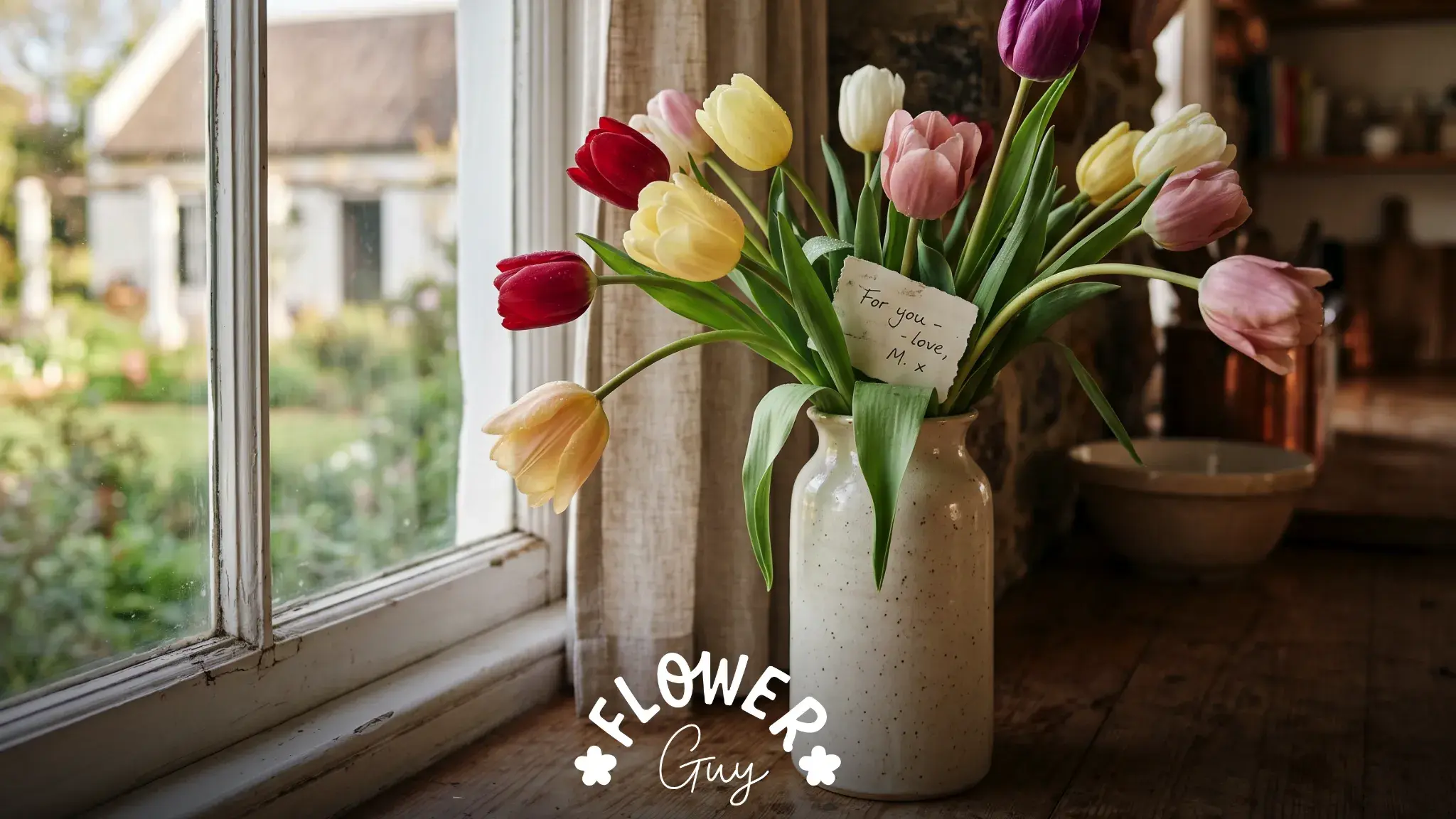
Tulips mean perfect love, declared simply. They carry less weight than roses but more romance than most other flowers, which makes them the right answer when you want to say something real without going full red-roses-on-Valentine's-Day. The Tulip Bouquets collection is one of our most-sent for this reason.
Red tulips are a direct declaration of love. The Persian legend has it that they sprang from the blood of a heartbroken prince, which is dramatic, but also explains the intensity attached.
Yellow tulips mean cheerful thoughts and sunshine in a vase. They have completely shed their old "hopeless love" meaning. Today they say thinking of you, hope this lifts your day.
White tulips mean forgiveness, a fresh start, and the good kind of let's try this again. Beautiful for apologies that are actually sincere.
Purple tulips mean royalty, abundance, and admiration. They feel like a luxury gesture without the expense.
Pink tulips mean affection, care, and confidence in someone's kindness. Send them to a mom, a sister, a friend who has been holding everyone together.
Lily Meanings: The Flower We Send for Sympathy and Rebirth
Lilies carry a wide spectrum of meaning depending on type and colour, but the core is consistent: purity, devotion, and renewal. The Lily Bouquet collection sits at the centre of both joyful and grieving moments.
White lilies mean purity, restored innocence, and peace. They are the most common sympathy and funeral flower in South Africa for that reason. They also feature heavily at weddings, where they carry the same sense of fresh beginnings.
Stargazer lilies (the pink-and-white speckled ones) mean ambition, prosperity, and the kind of person who takes up space without apologising. Brilliant for promotions, graduations, and big-deal birthdays. The stargazer is a gorgeous flower, and arguably the most photographed lily in the world.
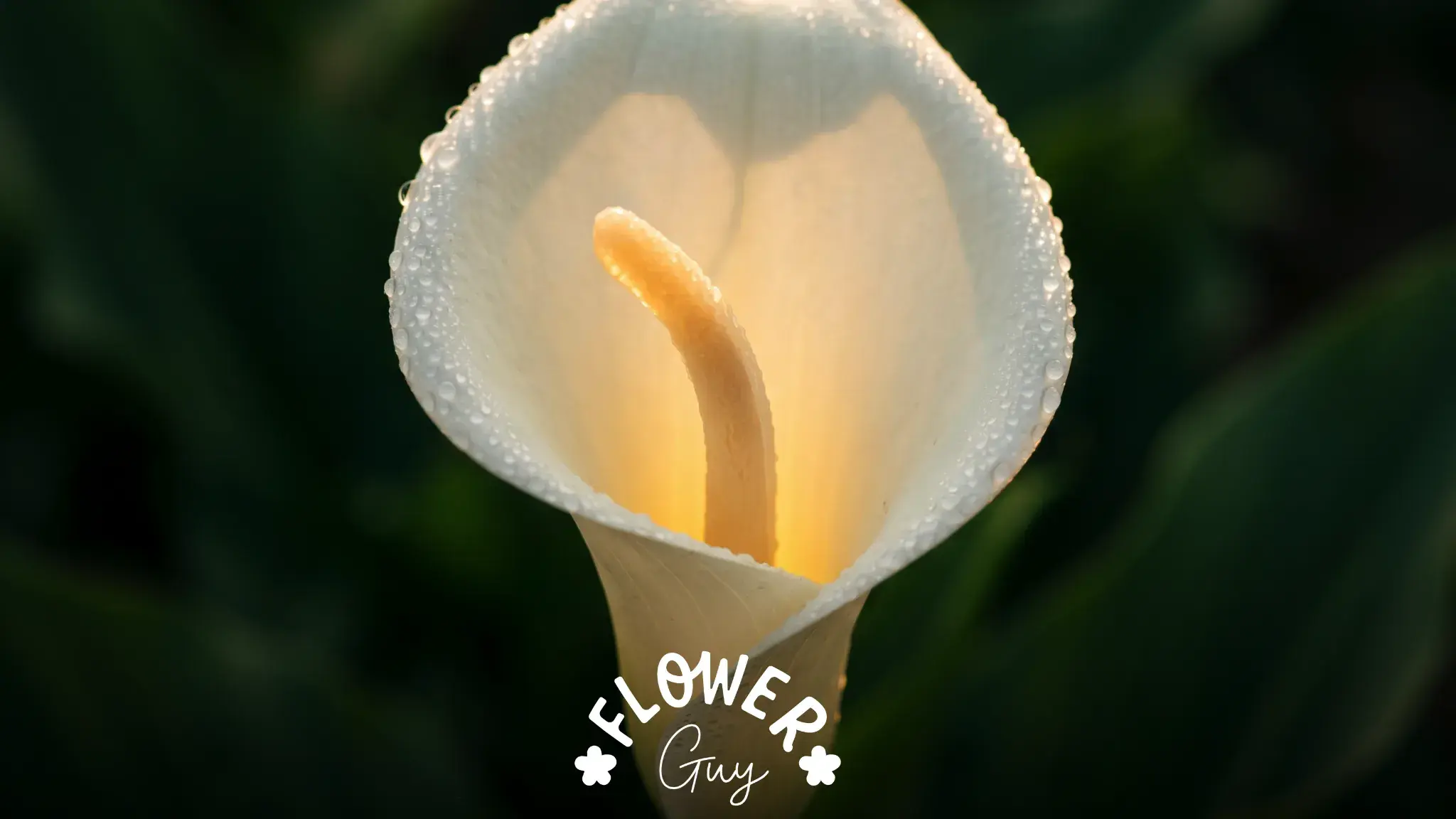
Calla lilies mean magnificent beauty and timeless elegance. They are an architecture flower, all clean lines, no fuss. Frequently chosen for weddings and high-stakes formal moments.
Tiger lilies (orange with dark spots) mean wealth, pride, and a touch of confidence. They are a flower with a personality.
Yellow lilies mean gratitude and cheerfulness. Lighter in tone than the white sympathy lily, they sit comfortably in everyday bouquets.
For a deeper read on lilies, our blog post on lilies and roses and the lilies bouquet guide cover the species and care side.
Sunflower Meanings: Loyalty, Adoration and a Bit of Swagger
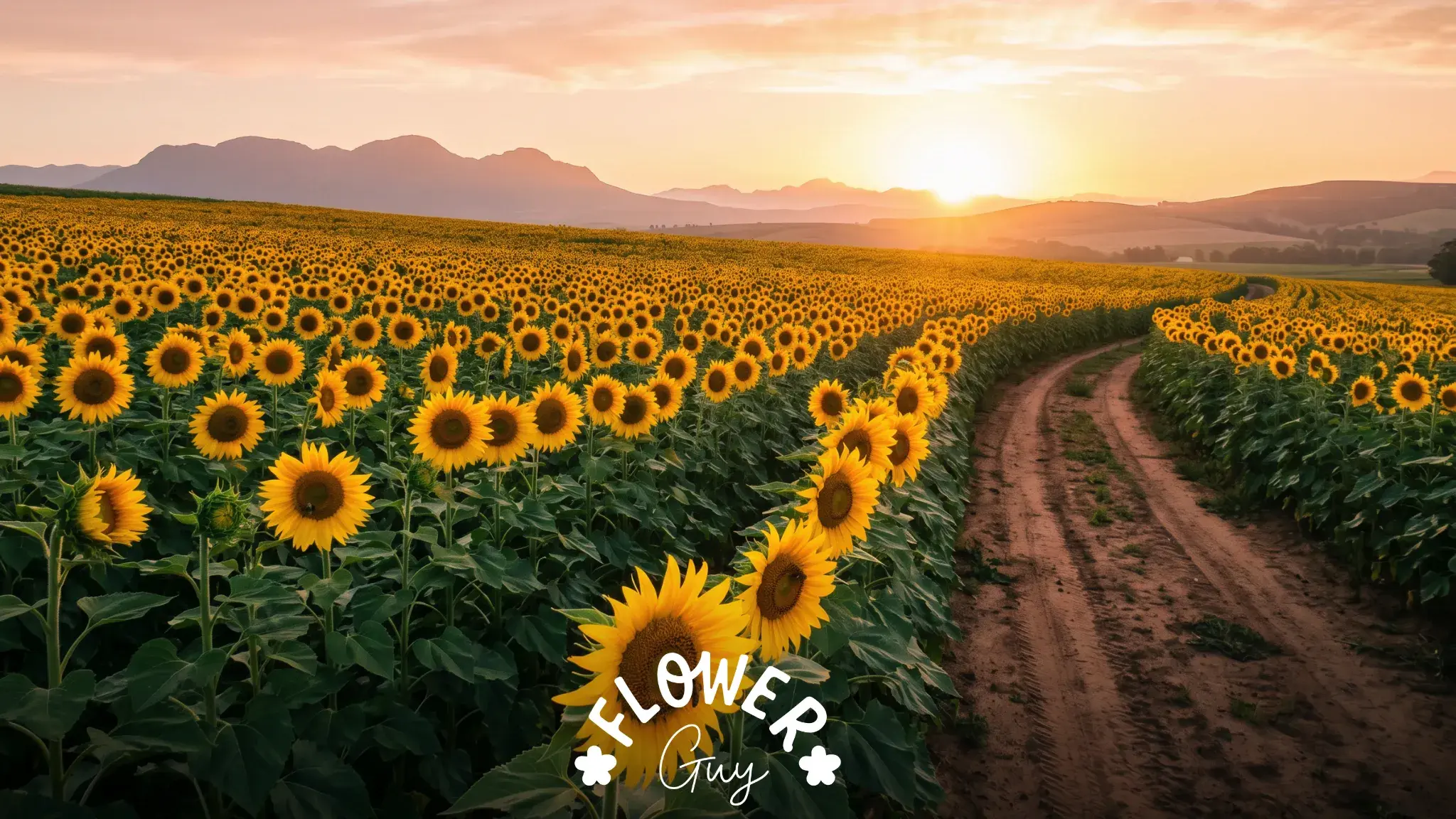
Sunflowers mean loyalty, adoration, and unwavering devotion. They literally turn their faces toward the sun all day, and that movement, called heliotropism, is where the symbolism comes from. They follow the light. They show up. They do not pretend to be smaller than they are.
Send them when you want to say I am completely on your team. They work for friendships, for anniversaries that are about appreciation, for somebody who has just got through a difficult stretch. The Sunflower Bouquet collection and the Sunstruck bouquet sit in this territory.
Sunflowers also carry meanings of warmth, optimism, and good luck. They are one of the few flowers that almost universally make people smile on receipt. If you are picking flowers and feeling stuck, sunflowers rarely miss.
Peony Meanings: Romance, Prosperity and a Slow Blush
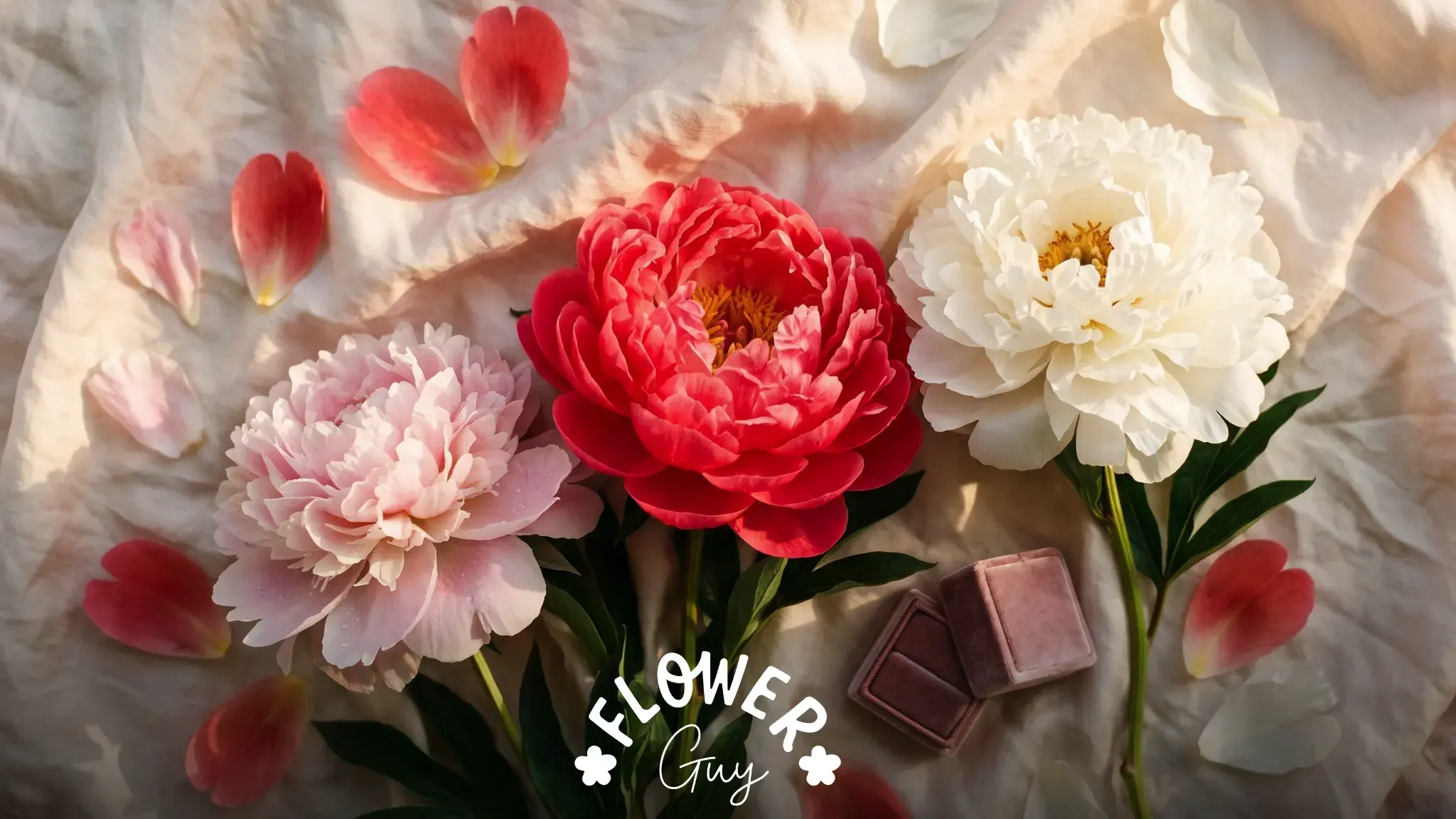
Peonies mean romance, prosperity, good fortune, and a happy marriage. In Chinese culture, peonies are the king of flowers, attached to wealth and honour. In Victorian flower language, they meant a happy life. Modern florists send them for engagements, twelfth wedding anniversaries (peony is the official flower), and any occasion where you want softness with substance. The peony is the kind of beautiful flower that makes a recipient pause when they open the door.
Pink peonies mean romance and a gentle, blossoming kind of love.
White peonies mean a fresh start, often used at weddings.
Coral peonies mean attention-getting elegance and are wildly popular for grand-gesture moments.
The Peony Bouquet collection is one of our most-asked-after for engagements and anniversaries. Peonies also pair beautifully into our Designer Bouquets and Statement Bouquets ranges.
Daisy, Gerbera and Chrysanthemum Meanings: Cheerfulness With an Edge
Daisies mean innocence, loyal love, and new beginnings. The Norse linked them to Freya, goddess of love and fertility, which is why they have long been associated with new motherhood and child-bearing. They are also the flower of the I love you, I love you not game, which gives them a flirty, low-stakes charm.
White daisies mean pure innocence and gentleness.
Coloured daisies like our Daisy Bouquet options carry cheerfulness and friendship. They are a beautiful flower for friendship moments because they manage to feel sincere without ever feeling heavy.
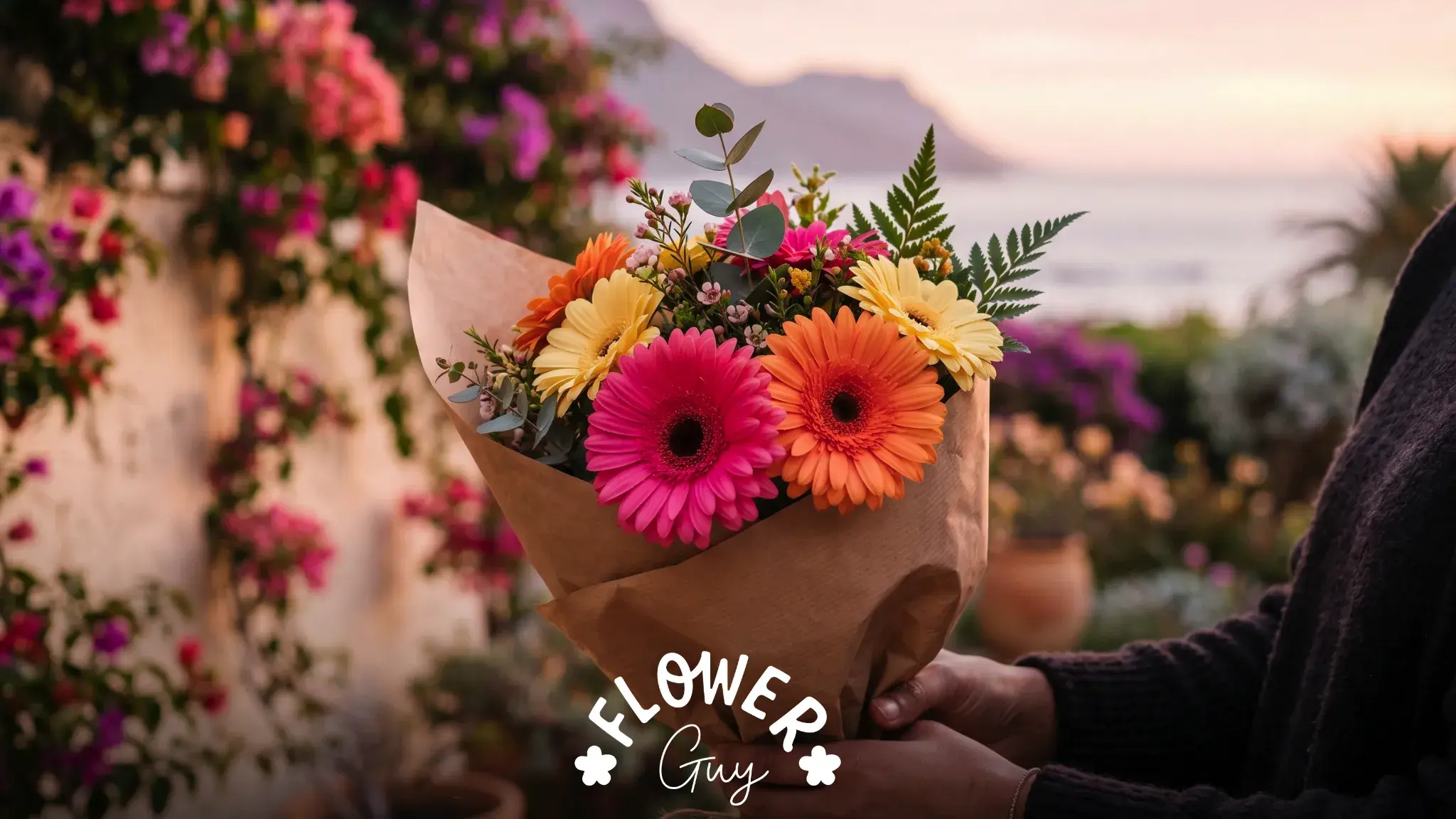
Gerbera daisies, with their oversized blooms, mean cheerfulness, beauty, and innocent gratitude. They are the flower for a friend who has done you a real favour. Pink gerberas read as soft and grateful. Red gerberas lean closer to passion. Yellow gerberas are pure sunshine.
Chrysanthemums (mums) are versatile flowers that can represent friendship, joy, and love, making them suitable for various occasions, including birthdays and celebrations. In the United States and South Africa, chrysanthemums generally represent happiness, longevity, and love. In much of Europe, especially France, Italy, and Belgium, they are a funeral flower and should not be sent for happy occasions. If you are gifting an expat or international diaspora friend, lean to roses or sunflowers instead unless you know they are happy with chrysanthemums.
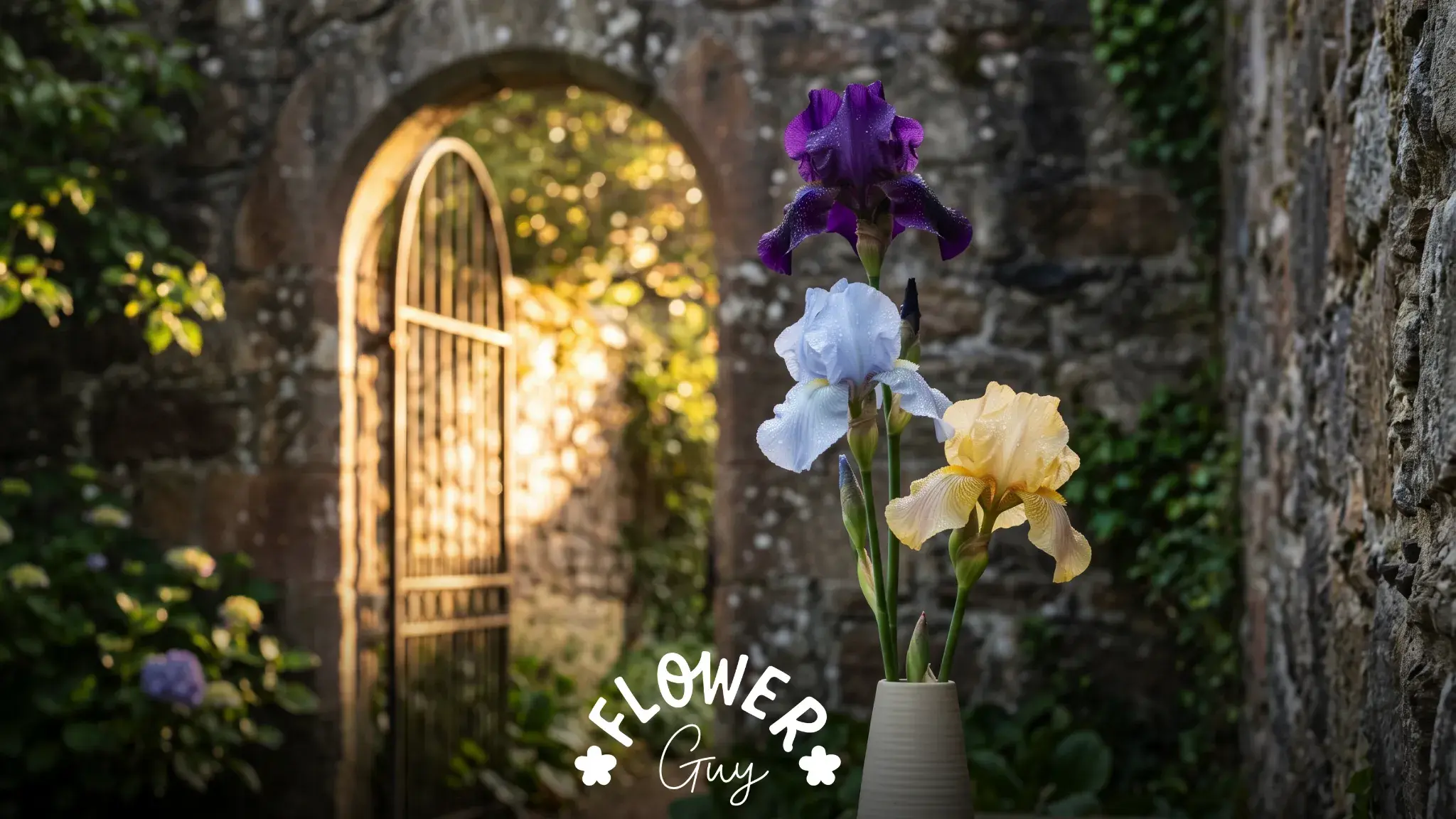
Iris Meanings: Royalty, Courage and Respect
The iris flower is traditionally associated with royalty, courage, and respect, with different colours conveying various meanings. The iris takes its name from the Greek goddess Iris, the messenger of the gods who travelled along the rainbow. The flower's wide colour range, from deep purple through blue, white, yellow and even near-black, mirrors that rainbow, which is why a single iris is said to carry messages between worlds.
Purple iris means royalty, wisdom, and admiration. It was the symbol of French monarchy as the fleur-de-lis, and remains the strongest of the iris colours.
Blue iris means faith, hope, and a calm kind of confidence.
White iris means purity and innocence, and pairs beautifully with white roses for weddings or sympathy.
Yellow iris means passion and a warm, friendly love.
The iris is also the February birth flower (alongside violet and primrose) and a popular tattoo flower for people who want to mark a transformation, a piece of wisdom, or a courageous chapter. Iris also features regularly in Designer Bouquets and Statement Bouquets for the dramatic shape and the rich colour saturation.
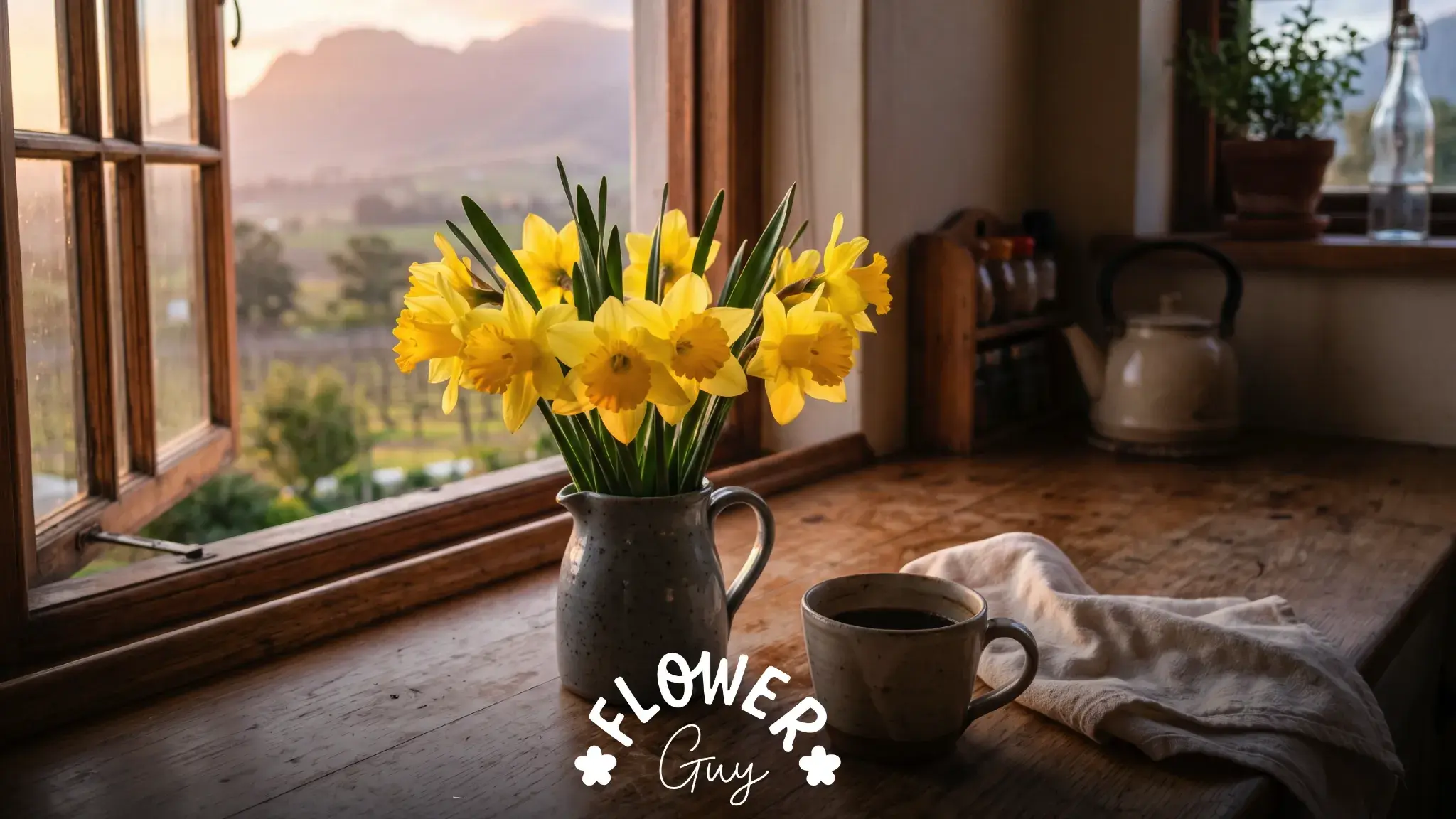
Daffodil and Narcissus Meanings: The Flower of Rebirth and New Beginnings
The daffodil is a symbol of rebirth and new beginnings, often associated with spring and hope. It is one of the very first flowers to push through the cold ground at the end of winter, which is why almost every culture that grows daffodils attaches them to renewal, fresh starts, and the return of life.
In Greek mythology, the daffodil is named for Narcissus, the beautiful young man who fell in love with his own reflection in a pool and was transformed into the flower that still bows its head toward water. The mythology gives the daffodil its second meaning: self-love, sometimes vanity, and the reminder to look outward rather than only at your own reflection.
In Welsh tradition, daffodils are the national flower, worn on St David's Day as a symbol of pride, hope, and homecoming. In Chinese tradition, the daffodil blooms around Lunar New Year and is a symbol of good fortune, good luck, and prosperity in the year ahead.
A single daffodil is said to bring misfortune. A bunch of daffodils brings happiness, joy, and good fortune. So if you are gifting a daffodil bouquet, always send a generous handful, never one stem. Daffodils make excellent housewarming, new-job, and welcome to a new chapter gifts. Pair them with the Housewarming Gifts collection or Just Because Gifts collection for the right energy.
Hydrangea, Orchid and Snapdragon Meanings: The Quietly Strong Ones
Hydrangeas mean heartfelt emotion, gratitude, and abundance. They also carry a meaning of perseverance and weathering storms, which is why they are popular at sympathy moments and after-hard-times bouquets. The colour shifts the meaning further: blue hydrangeas lean toward apology and frigidity (yes, really, in old floriography), while pink hydrangeas mean genuine emotion and a heartfelt thank you. White hydrangeas mean grace and abundance.
Orchids mean luxury, refined beauty, and rare elegance. The Victorians associated them with rarity because they were difficult and expensive to grow. Today they carry a sense of I noticed you, and I went to some trouble. They are a thoughtful gesture, often gifted as a potted plant rather than a cut bouquet. They are popular alongside the Luxury Flower Bouquet and Premium Bouquets ranges for high-stakes gifting.
Snapdragons mean grace under pressure, deception (in old language), and inner strength. They get their name from the way the bloom looks like a tiny dragon's mouth that snaps when you squeeze it. They are a flower for someone who has been holding it together through something hard. Our blog post on the language of snapdragons goes deeper.
Carnations carry their own coded language. Red carnations mean deep love and admiration. White carnations mean pure love and good luck. Pink carnations are tied to a mother's eternal love and are the original Mother's Day flower. Yellow carnations historically meant disappointment, so be careful with those. Striped carnations mean I cannot be with you, which is a brutally specific Victorian invention. Modern usage has softened most of these, but if you are shopping for a romantic message, keep the colour intentional.
Baby's breath, the small flowers in clouds of white that fill out larger arrangements, means everlasting love and innocence. These small flowers are most often used as a supporting bloom in wedding work, but they are a meaningful filler in their own right. The Baby Breath Flowers collection works as a standalone gesture for sentiment that does not need to shout, and pairs beautifully alongside any of the bigger statement blooms when you want a delicate counterpoint of small flowers around a larger feature.
Calla Lily Meanings: Magnificent Beauty for Weddings and Sympathy
Calla lilies deserve their own section because their meanings are both more specific and more layered than the broader lily family. The calla lily means magnificent beauty, sophistication, and timeless elegance. The architectural shape, all clean curves and a single graceful spadix, has made it the most-photographed wedding bouquet flower of the last hundred years.
White calla lilies mean purity, innocence, and the kind of magnificent beauty that does not need decoration. They are the classic wedding bouquet flower, often paired with white roses, peonies, and orange blossom for a ceremony that wants to lean traditional and refined.
Yellow calla lilies mean gratitude and joy, and work beautifully for thank-you moments and friendly congratulations.
Pink calla lilies mean appreciation and admiration, with a softness that pairs them well with sympathy and thinking of you gestures. They are a gorgeous flower for delicate moments where you want elegance without the weight of a fully-grown bouquet.
Purple and dark calla lilies mean royalty, mystery, and a darker romantic energy, and have grown popular at modern weddings for couples who want something more dramatic than the standard white.
Calla lilies also feature heavily in funeral arrangements, where their shape carries a meaning of resurrection, eternal sleep, and the soul's passage. They appear in Christian art constantly as the trumpet that announces resurrection. The calla lily lasts an exceptionally long vase life, making it one of the more practical premium flowers to send. They feature in our Lily Bouquet, Luxury Flower Bouquet, and Premium Bouquets ranges.
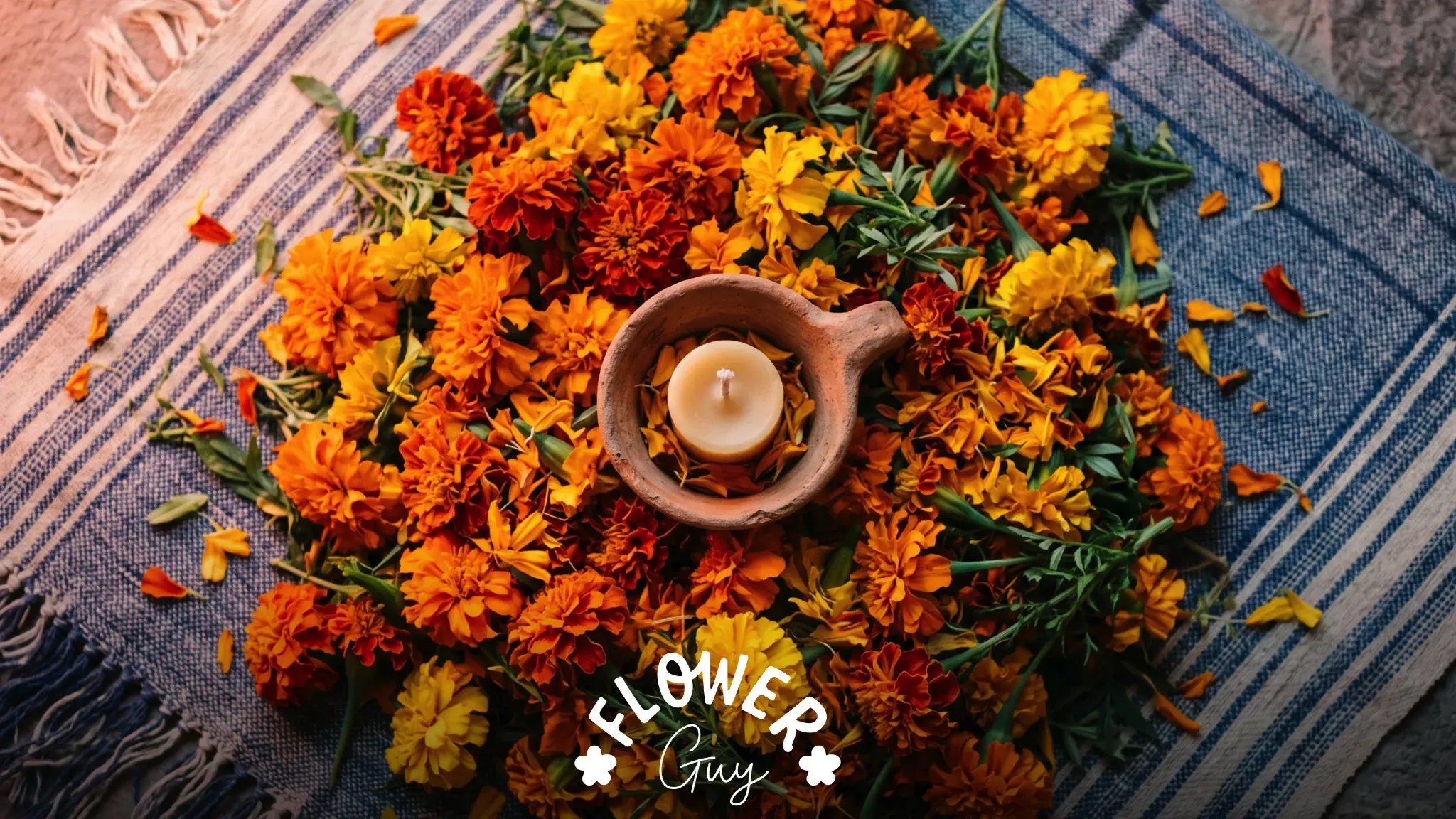
Marigold Meanings: Day of the Dead and Day of the Living
Marigolds carry some of the most regionally divided meanings of any flower. In Mexico, marigolds are essential to Day of the Dead celebrations, believed to guide the spirits of the departed back to their families with their vibrant orange colour and unmistakable musky scent. In India, they are the wedding flower, the temple flower, the festival flower, woven into garlands by the kilometre. In Victorian Britain, they meant grief and despair.
In South Africa, marigolds carry their warmer modern meanings: warmth, creativity, powerful emotion, and the bright joyful gold of late summer. They are the October birth flower, paired with cosmos. Send marigolds for a creative person's birthday, for somebody starting an art project, for a gardener moving into a new home, or for a welcome to spring moment. Their long vase life and tough stems make them practical too.
The marigold's botanical name is Tagetes, and the flower has a rich history in Aztec, Hindu, and Mediterranean traditions. They were used as a sacred offering, a medicinal herb, and a dye long before they ended up in suburban garden borders. The colour and scent that some Europeans found strange were exactly what made the marigold sacred elsewhere. It is a useful reminder that flower meanings are not universal, and the same bloom can carry exotic beauty in one tradition and quiet domesticity in another.
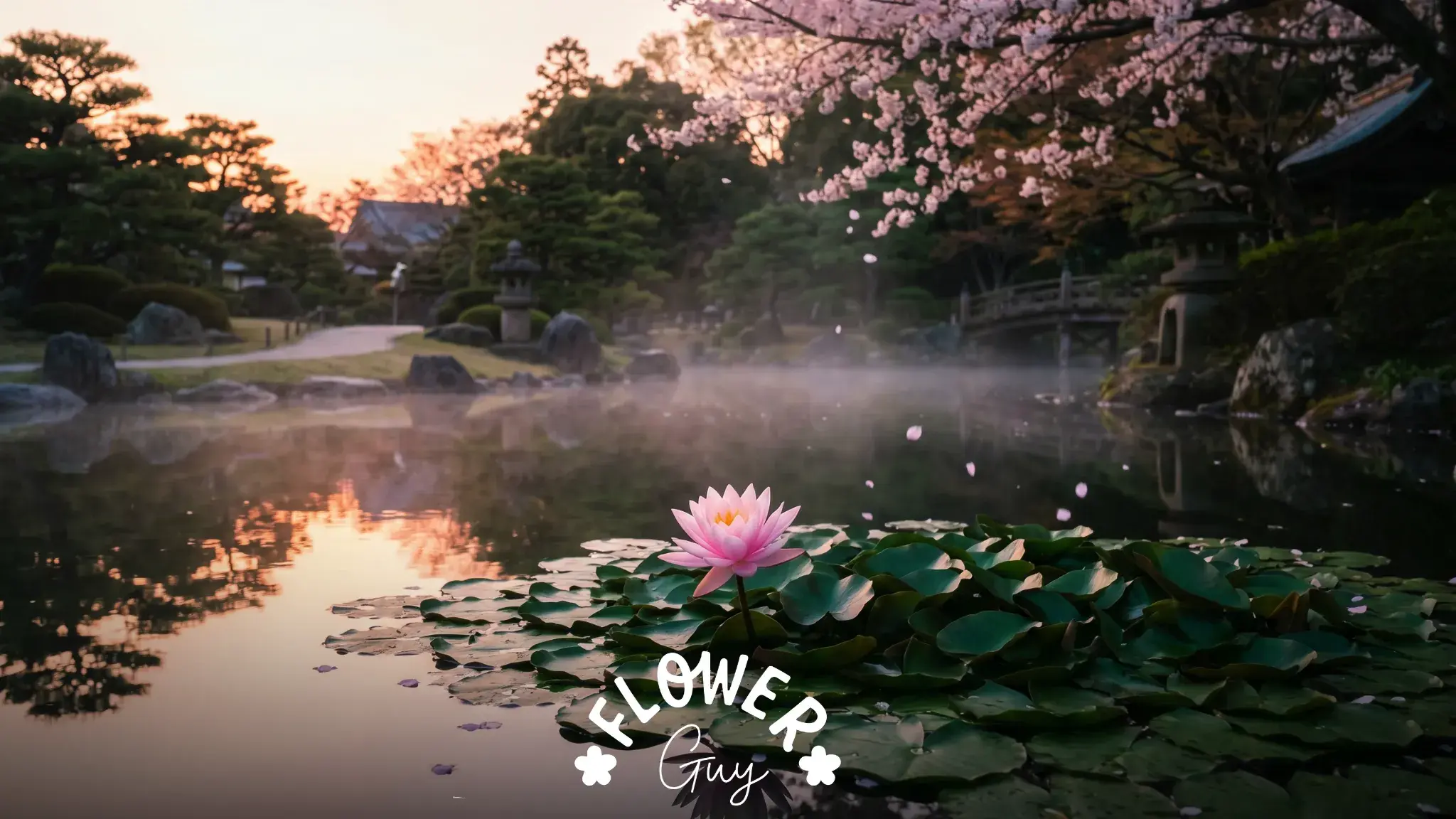
Cherry Blossom and Lotus Meanings: The Sacred Asian Blooms
Two flowers from East and South Asia carry meanings deep enough to warrant their own section, even though we do not stock them as cut flowers in South Africa. They appear in tattoos, in art, in poetry, and in conversation often enough that you should know what they mean.
Cherry blossoms (sakura) in Japan represent the transience of life and the fleeting nature of existence. They are the flower of mono no aware, the beautiful sadness of impermanence. They bloom for less than two weeks every spring, then fall like snow, and the entire country pauses for hanami, the traditional Japanese custom of flower viewing where people gather under the trees with food, drink, and friends to acknowledge the brief, perfect bloom.
Cherry blossoms also mean new beginnings, since they bloom at the start of the school and business year in Japan. They appear constantly in Japanese art, anime, and tattoo tradition. A cherry blossom tattoo can mean appreciation of beauty, mortality, the bravery of a samurai, or the love of someone now gone. Pink cherry blossoms are the most common. White cherry blossoms (shidare-zakura) carry a quieter, more reflective meaning. The cherry blossom is the kind of beautiful flower that has shaped an entire national aesthetic, and many flowers in Japanese culture carry comparable layered symbolism.
The lotus is a sacred symbol in Hinduism and Buddhism, representing the journey of the soul toward spiritual awakening. It grows out of muddy water and emerges spotless, which became the metaphor for enlightenment rising from the mess of human existence. In Hindu iconography, deities like Vishnu, Lakshmi, and Saraswati are depicted seated on lotus thrones. In Buddhism, the eight-petalled lotus mirrors the Eightfold Path.
White lotus means spiritual perfection and mental purity. Pink lotus means the supreme lotus, the lotus of the Buddha himself. Red lotus means the heart, compassion, and pure love. Blue lotus means wisdom, knowledge, and the victory of spirit over senses. Purple lotus means esoteric awakening and the mystical path.
The lotus also appears in Ancient Egyptian iconography as a symbol of rebirth and the rising sun. In modern usage, a lotus tattoo or lotus motif almost always carries one of these spiritual meanings: rising above difficulty, growing through hardship, awakening, or a hard-won inner peace.
Heather, Orange Blossom, Sweet Pea and Morning Glory: The Quiet Romantic Flowers
These four flowers are quieter than roses but carry meanings worth knowing, especially for weddings, anniversaries, and small thoughtful gifts.
Heather flowers mean good luck, admiration, and protection in Scottish tradition. White heather is particularly associated with good fortune and is often woven into Scottish wedding bouquets for that reason. Purple heather means admiration and solitary beauty. Heather is also a flower of remembrance, often planted in memorial gardens.
Orange blossom means eternal love, fertility, and a happy life. It became the bridal flower across Europe in the 19th century, when Queen Victoria wore orange blossom in her 1840 wedding crown and started a tradition that lasted a hundred years. Orange blossom carries a sweet fragrance that has made it a popular flower for wedding bouquets, perfumes, and bridal hair pieces. The flower's meaning of pure love, eternal love, and a new married life makes it the classic wedding bouquet addition.
Sweet pea means blissful pleasure, delicate pleasure, and goodbye. It is the April birth flower (alongside the daisy) and one of the most-loved cottage garden flowers in the world. The sweet fragrance is part of why it carries a goodbye meaning: the Victorians sent sweet pea bouquets at the end of a visit or the close of a friendship, as a way of saying thank you for the lovely time, until we meet again. Modern usage has softened the goodbye meaning. Today, sweet pea reads mostly as gentle, romantic, and nostalgic.
Morning glory means affection, love that returns each day, and (in old language) mortality, since the flowers open in the morning and die by evening. The Aztec priests treated morning glory seeds as sacred. The Victorians used the flower as a symbol of love that could not last, but in modern usage it leans almost entirely toward affection and the small everyday joys. It is the September birth flower (alongside aster).
These four flowers tend to feature in Designer Bouquets and seasonal arrangements rather than as standalone bouquets. They are the supporting cast that gives a bouquet its character.
Wedding Bouquet Flowers and Their Meanings
A wedding bouquet is the single most meaningful floral arrangement most people will ever hold. Every flower in it has been chosen, traditionally, for what it says about the couple, the love, the hope for the marriage, and the family being formed. Knowing the meanings helps you build a bouquet that actually says something on a day that matters.
The classic Western wedding bouquet leans on a small set of flowers with consistent meanings:
White roses mean pure love, new beginnings, and unity. They are the foundation of most traditional white-and-green wedding bouquets.
Peonies mean a happy marriage, prosperity, and good fortune. The Chinese consider peonies the king of flowers and a symbol of a happy life. Peonies are wildly popular for late spring and early summer weddings.
Orange blossom means eternal love, fertility, and a sweet fragrance that lingers in the memory. The bridal flower of Queen Victoria.
Calla lilies mean magnificent beauty, sophistication, and a refined elegance.
Lily of the valley means humility, sweetness, and a return to happiness. Kate Middleton carried lily of the valley in her 2011 royal wedding bouquet. The bell-shaped small flowers carry a quiet sweetness that fills a room without ever asking for attention.
Baby's breath means everlasting love and the small enduring joys.
Stephanotis (Madagascar jasmine) means marital happiness and is a long-traditional wedding flower.
Hydrangeas mean heartfelt emotion and gratitude, popular for outdoor and garden weddings.
Gardenias mean secret love, joy, and a sweet love that is held close. Their heady fragrance has made them a wedding favourite for over a century.
Modern wedding bouquets often add proteas, sunflowers, succulents, and South African indigenous flowers for colour and meaning. A protea in a bridal bouquet says this marriage is built to last and to weather everything, which is a meaning few imported flowers can match. Strelitzia in a wedding bouquet says this is a new chapter and a paradise found. We supply many of these blooms through our Designer Bouquets, Premium Bouquets, and Statement Bouquets collections.
If you are gifting flowers to a bride, the safest cross-cultural choices are white roses, peonies, calla lilies, and orange blossom. Avoid red roses (they read as romantic between giver and recipient, not as a wedding gesture), avoid yellow flowers in some cultures (jealousy meanings), and never send chrysanthemums to a European wedding (funeral flower).
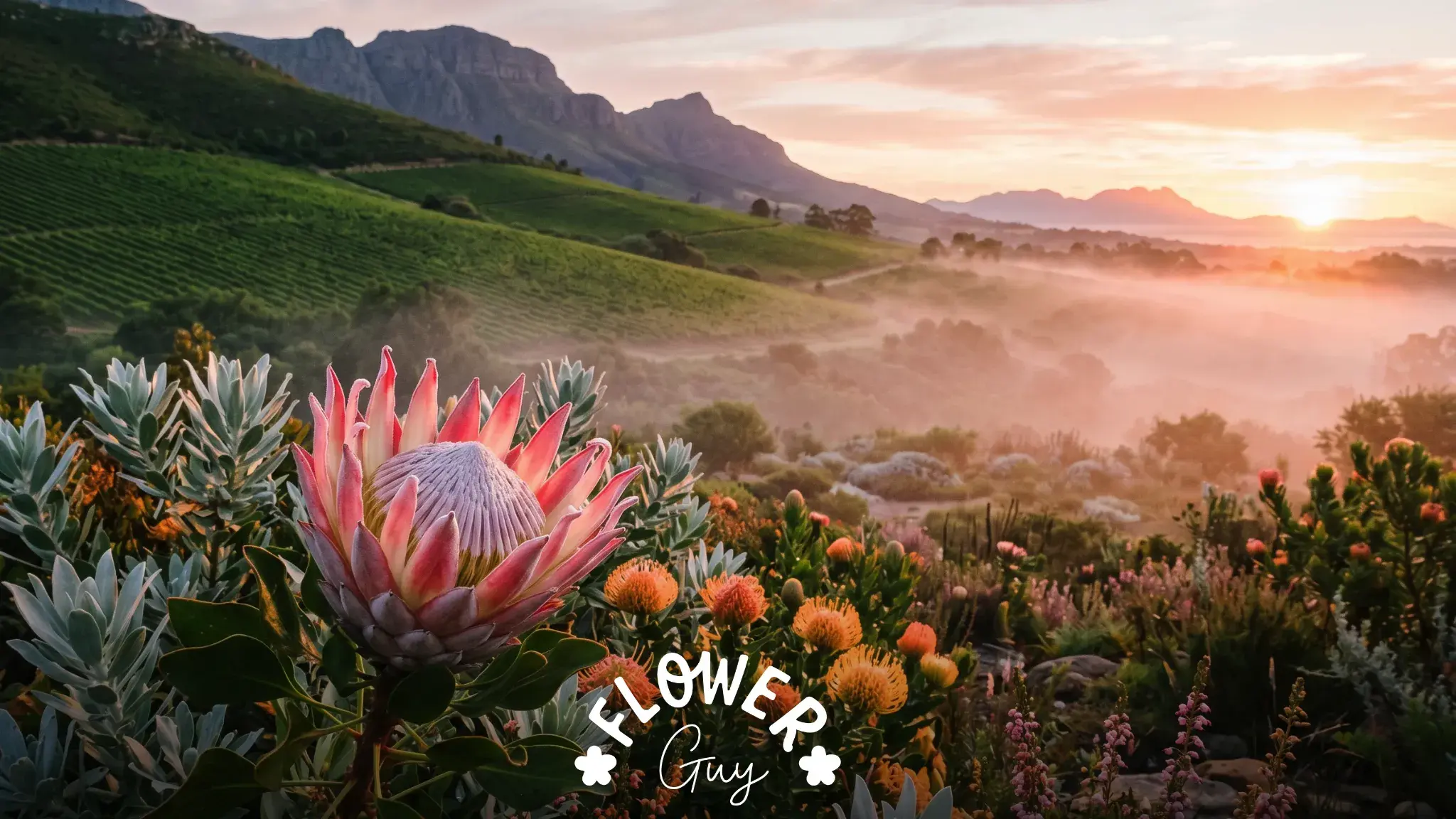
South African Flowers and Their Meanings: Protea, Strelitzia, Pincushion and Fynbos
Most flower meaning guides skip South Africa entirely, which is strange given that we have some of the most symbolically loaded flowers on the planet. We grow them in our gardens, see them on our currency, and put them in everything from wedding bouquets to Springbok jerseys.
The protea is South Africa's national flower and the meaning is layered: change, transformation, courage, and diversity. It takes its name from the Greek god Proteus, who could shift form at will. Proteas thrive in fynbos, regenerate after wildfires, and outlast almost every other bloom in a vase. To send a protea is to say you are resilient and remarkable. The Protea Bouquet and Simple Protea Bouquet collections honour this.
The king protea specifically carries meanings of leadership, regal beauty, and strength of character. It is the species on our coat of arms, and gifting one carries weight that imported flowers cannot match.
The pincushion protea (leucospermum) means resilience and courage in the face of difficulty. The bloom looks like a literal pincushion stuck with bright orange or yellow needles, and it is one of the toughest flowers on earth. We use it in our Wild Honey Silk Bouquet for its shape and symbolism.
Strelitzia, also called the bird of paradise, means freedom, joyfulness, and a sense of paradise found. The shape mimics a bird taking flight. Send it for a new chapter, a move, a graduation, or any moment that feels like wings unfolding. Strelitzias feature in many of our Statement Bouquets.
Fynbos as a category, the unique kingdom of plants found nowhere else on Earth except the Cape Floral Region, means home, rootedness, and belonging. Sending fynbos to a South African abroad, or to someone who has just bought a Cape home, carries an emotional weight that no imported rose can match.
This is the section nobody else covers, and it is one of the things we know better than anyone shipping flower-meaning content from the United States or the United Kingdom. We grow up with these flowers. We know what they say.
What Flowers Represent: A Quick Symbolic Guide to Common Blooms
Before we dive deeper, here is the fast lookup table for what flowers represent at a glance. This is the chart you keep in mind when you walk into a florist and need to choose flowers under pressure. Every specific flower in this guide carries its own coded meaning, and many flowers carry hidden meanings that reach back to Greek mythology, the Victorian era, or older Asian and African traditions. Different flowers can also carry slightly different meanings depending on colour, country, and the era of the floriography handbook the meaning came from. Read this section as a foundation, not a final word.
Roses represent love (red), purity (white), gratitude (pink), friendship (yellow), enthusiasm (orange), and enchantment (lavender).
Lilies represent purity, virtue, devotion, and the Virgin Mary in Christian symbolism.
Tulips represent perfect love, elegance, and a declaration without words.
Sunflowers represent loyalty, adoration, and unwavering devotion.
Daisies represent innocence, loyal love, and new beginnings.
Peonies represent romance, prosperity, a happy marriage, and good fortune.
Orchids represent exotic beauty, refined elegance, and rare luxury.
Hyacinths represent sincerity, constancy, and (in old language) regret.
Lilacs represent first love and youthful innocence.
Marigolds represent joy, warmth, creativity, and the souls of the departed in Mexican tradition.
Poppies represent restful sleep, consolation, eternal sleep, and remembrance.
Chrysanthemums represent friendship, joy, and honesty in some cultures, and mourning in others.
Jasmine represents sensuality, grace, and elegance.
Violets represent modesty, humility, and faithful love.
Carnations represent love and admiration, with a different meaning attached to each colour. White carnations represent pure love and good luck. Red carnations represent deep love. Pink carnations represent a mother's love. Yellow carnations represent disappointment in old language. White carnations are often called the apology flowers because they signal sincere intentions and a desire for a fresh start.
Magnolias represent dignity, nobility, and a love of nature.
Cosmos represent harmony, tranquillity, and a settled peace.
Asters represent love, faith, patience, and elegance.
Forget-me-nots represent true love, remembrance, and a promise to keep someone in your thoughts. They are small flowers with one of the most loyal meanings in the entire floriography handbook.
Daffodils represent rebirth, new beginnings, and good fortune.
This list is the foundation. Almost every other flower meaning grows out of these basics, layered with colour symbolism and cultural context. When in doubt, lean on what flowers represent in their classic, most agreed-upon meanings. The fancier you get, the more you risk sending mixed signals.
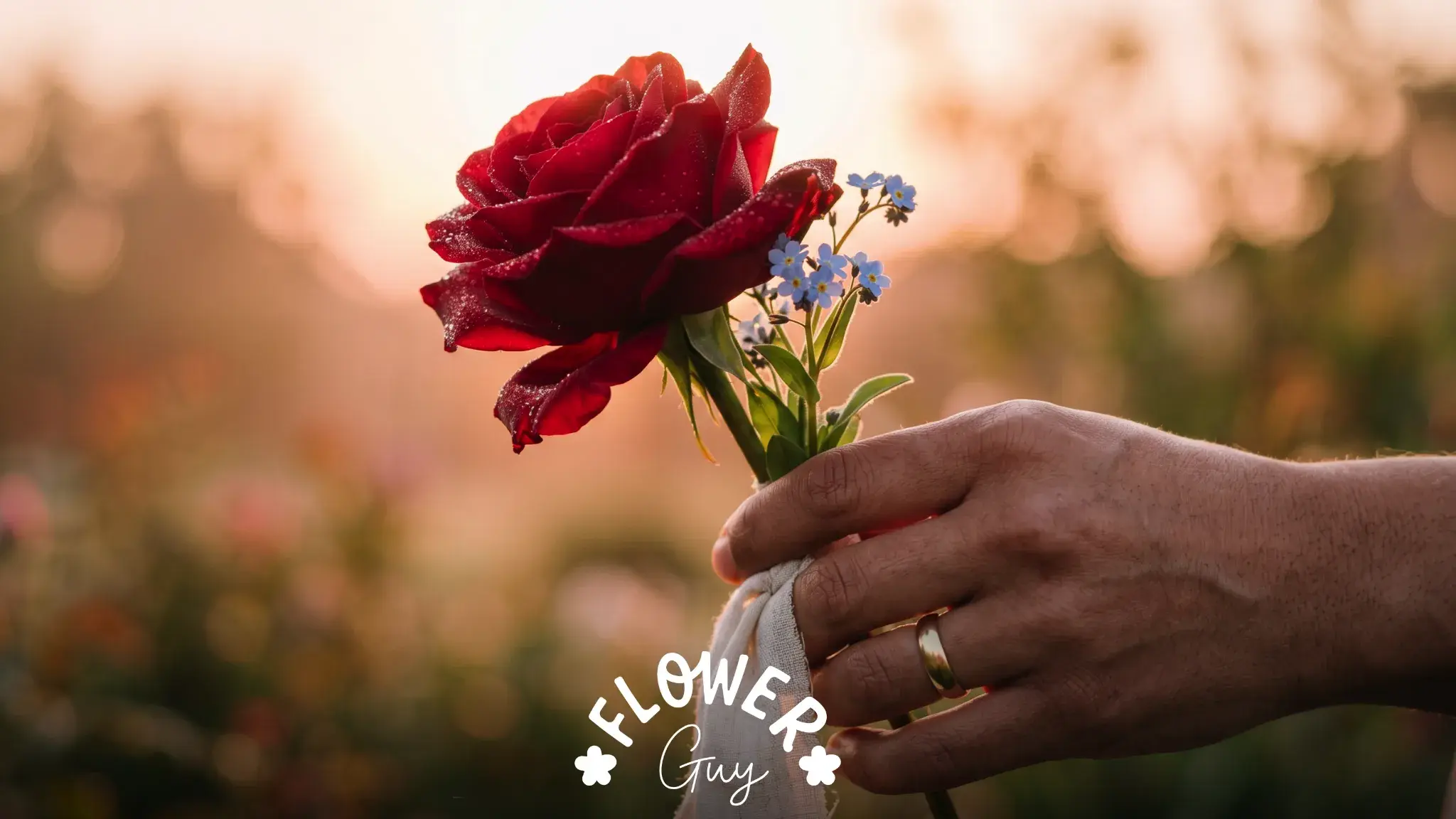
The Many Meanings of Love in Floriography
Love is the most diverse meaning in the language of flowers. Almost every culture, every era, and every floriography handbook spends most of its pages on the different kinds of love, because love is the most common reason humans have ever sent flowers in the first place. Knowing the variations helps you pick the perfect bloom for the perfect moment.
Passionate love is the territory of red roses, especially long-stemmed red roses, deep red tulips, red carnations, and bold red dahlias. These flowers say I want you, I think about you, I am not subtle. The Red Flowers collection is built around this energy.
Pure love is the territory of white roses, white lilies, white tulips, and orange blossom. These flowers carry a meaning of love that is honest, untainted, and committed. Pure love flowers feature heavily in wedding bouquets for exactly this reason.
Sweet love lives in pink roses, peonies, lilac, and gerbera daisy. These are the flowers of gentle affection, the slow-blooming kind of love that grows over time rather than crashing in all at once.
Eternal love is the territory of orange blossom (which Queen Victoria wore for that very meaning), red carnations, ivy, and forget-me-nots. These flowers say as long as I am alive, this remains. Forget-me-nots in particular carry a meaning of true love and remembrance that has lasted for centuries.
Secret love lives in gardenia, yellow acacia, and red tulip in some traditions. The Victorian language of flowers used these blooms to communicate love that could not yet be declared in public. Sending a single gardenia in old floriography meant I love you in secret, please notice me.
Unconditional love is the territory of pink carnations (the original Mother's Day flower, attached to a mother's love that does not waver), peonies, and chrysanthemums in Asian tradition. These flowers carry a sense of love that does not need conditions to keep showing up.
Undying love lives in red roses, peonies (the twelfth-anniversary flower), and pink camellias. They are the long-marriage, long-friendship, long-loyalty flowers.
Loyal love is the territory of sunflowers (which literally turn to follow the sun all day, never breaking faith), daisies, and irises. These flowers say I am here, I am consistent, I am not going anywhere.
When you are choosing flowers for a romantic moment, picking the right kind of love matters. A red rose for a long marriage carries different weight to a red rose for a first date. A peony for an engagement says something different to a peony for a friendship. Match the flower to the kind of love, not just the relationship.
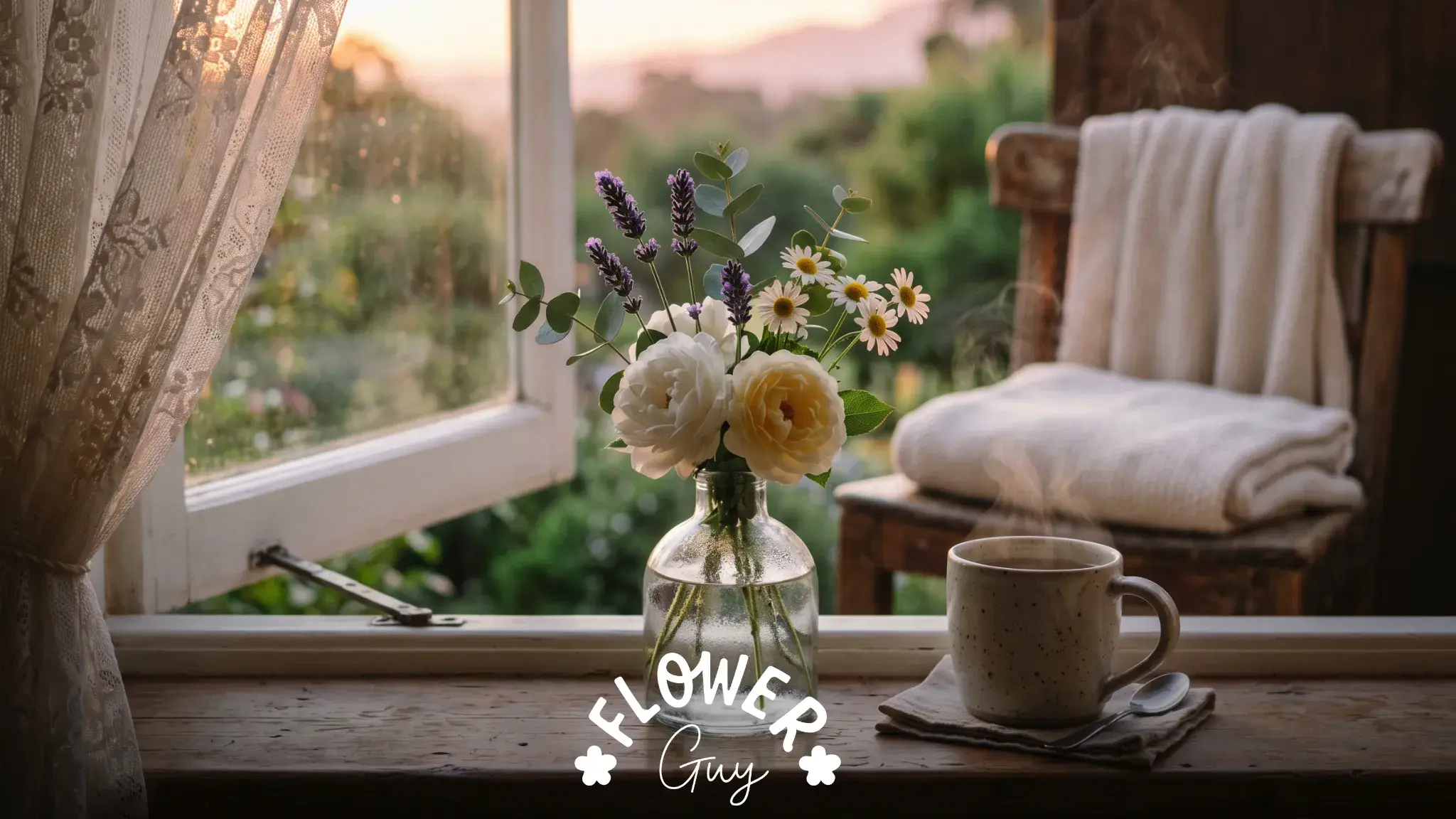
Healing Flowers: What They Actually Say
Healing flowers are flowers historically associated with recovery, comfort, and restoration. They feature heavily in the get-well-soon tradition, in convalescence bouquets, and in the gestures we make when somebody we love is having a hard time. Some of this is symbolism. Some of it is genuine biology , research consistently shows that fresh flowers in a hospital room or recovery space measurably improve mood and reduce stress. We have written about this in our blog post on flowers and affirmations.
White roses mean peaceful healing and quiet support.
Yellow roses mean cheerful recovery and friendship through hard times.
Sunflowers mean unwavering loyalty during illness, the I'm not going anywhere flower.
Peace lilies mean tranquillity, restoration, and a calm space to heal in.
Daisies mean lightness, hope, and the small everyday joys that hold a person together.
Chamomile, traditionally, means patience and gentle restorative care.
Lavender means calm, soothing rest, and recovery from anxiety or stress.
Eucalyptus means protection, clearing, and a fresh breath of air, which is why it features in so many Get Well Soon Gifts.
When somebody is going through it (surgery, illness, grief, burnout, rough mental-health season, the lot), pick from this list. Or pick from our Get Well Soon Gifts collection, which is built around exactly these blooms.
Healing flowers also carry meanings tied to good health and general well being. Giving flowers to a hospital room, a recovery space, or a family member who has been unwell is a thoughtful gift that does practical work alongside its symbolism. Flowers genuinely improve a recovering patient's mood. They mark the room as cared for. They give someone a small piece of beauty to look at when most of the day is hard. The right healing flowers do not need to mean anything elaborate. They just need to show up.
Black Flowers and Their Meanings: Rebellion, Mystery and Farewell
Black flowers are rare in nature. Almost every flower marketed as black is actually a very deep purple, maroon, or burgundy variety: black calla lily, black baccara rose, black tulip, black bat flower, black hellebore, black dahlia. True jet black flowers do not exist as natural species, so when you see them in arrangements, they have been carefully bred or dyed for the colour.
Black flowers carry meanings of farewell, ending, mystery, and rebellion. In old floriography they signalled mourning or the close of a chapter. In modern floral arrangement and wedding work, they have shifted toward elegance, drama, and a counterculture energy. A black-and-red bridal bouquet says we are not interested in pastels and we know exactly who we are. A black flower in a sympathy arrangement says this loss is heavy and we are not pretending otherwise.
The black baccara rose is the most popular and most accessible black flower. It is technically a deep velvety burgundy that reads as black under most light. It carries the meaning of mysterious love, deep passion, and a love that exists beyond the ordinary. The black calla lily, similarly, means farewell with grace and a particular dark elegance.
If you are building a floral arrangement with black flowers, balance them with whites, deep greens, or ivory to keep the bouquet from reading as funereal. Black flowers gain their meaning from contrast, which is why they have become a popular choice for modern, fashion-forward, and statement bouquets.
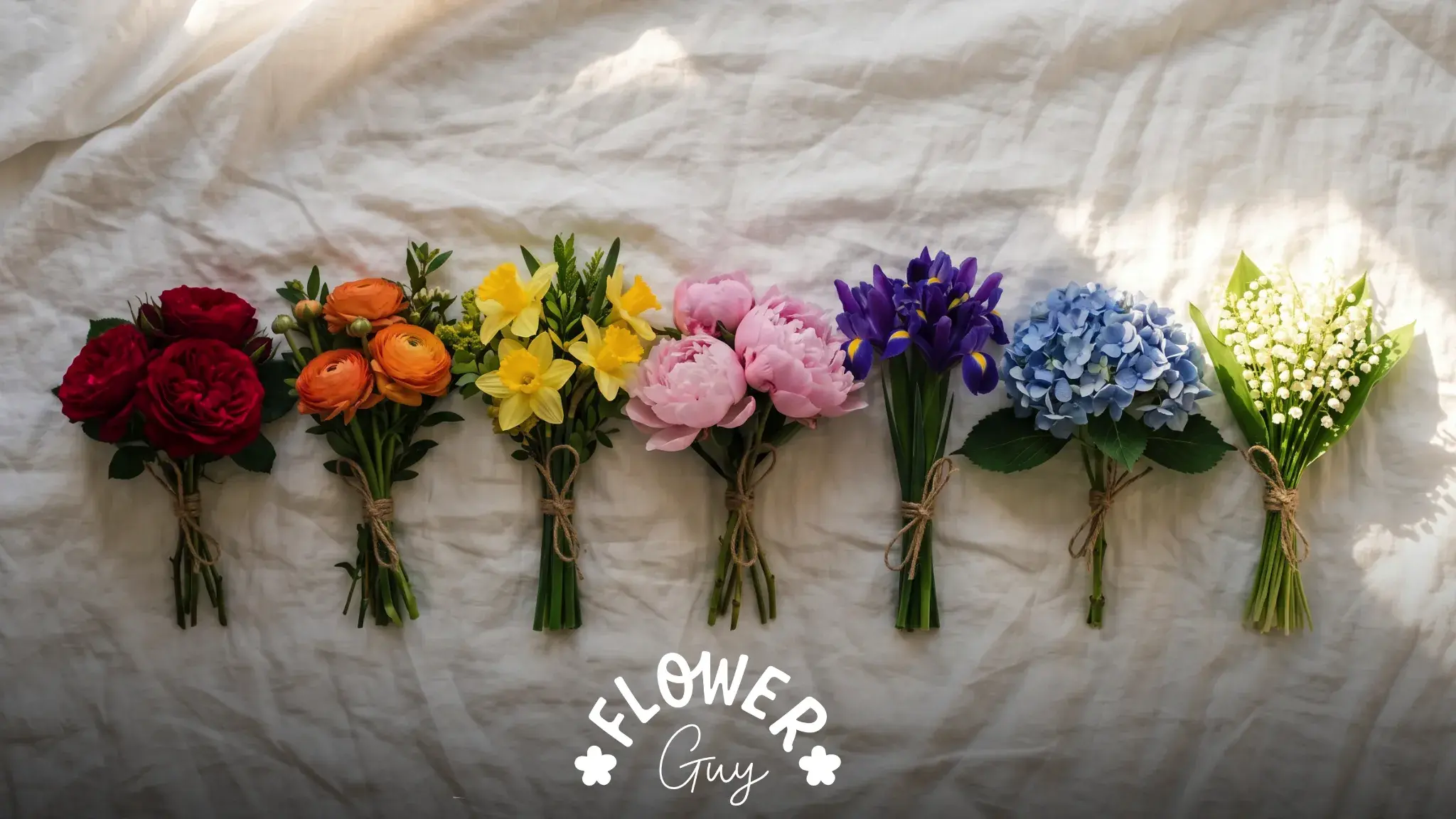
Flower Colour Meanings: What Every Shade Really Says
If you remember nothing else about flower meanings, remember the colour rules. They cut across species and give you a fast read on any bouquet.
Red flowers mean love, passion, deep desire, and strong feeling. They are the colour of romance in almost every culture. The Red Flowers and Red Flower Bouquet collections cover the territory.
Pink flowers mean affection, gratitude, gentleness, and femininity in its broader sense. They span everything from the soft thank you for being kind of pale pink to the I am into you of hot pink. The Pink Flower Bouquet collection includes both ends.
White flowers mean purity, peace, sympathy, and reverence. They are the safest cross-cultural choice when you do not know somebody well, and they are the standard sympathy and funeral colour in South Africa. The White Flower Bouquet collection sits here.
Yellow flowers mean friendship, joy, optimism, and I'm thinking of you. They are the cheering-up colour. The Yellow Flowers collection covers it.
Orange flowers mean enthusiasm, warmth, and creative energy. They sit between the friendliness of yellow and the passion of red, which makes them the right answer for something exciting is happening and I want to mark it. The Orange Flowers collection lives here.
Purple flowers mean dignity, admiration, success, and a touch of mystery. They have historically signalled royalty because purple dye was once expensive. Send them for a graduation, a promotion, or a milestone. The Purple Flowers collection covers it.
Blue flowers mean serenity, trust, and quiet calm. They are also rare in nature, which makes them feel intentional. The Blue Flowers collection works for someone who notices unusual choices.
Mixed colourful bouquets mean joy, abundance, and the whole spectrum of feeling at once. They are the I am sending you everything good bouquet. The Colourful Flowers and Mixed Flower Bouquet collections cover this energy.
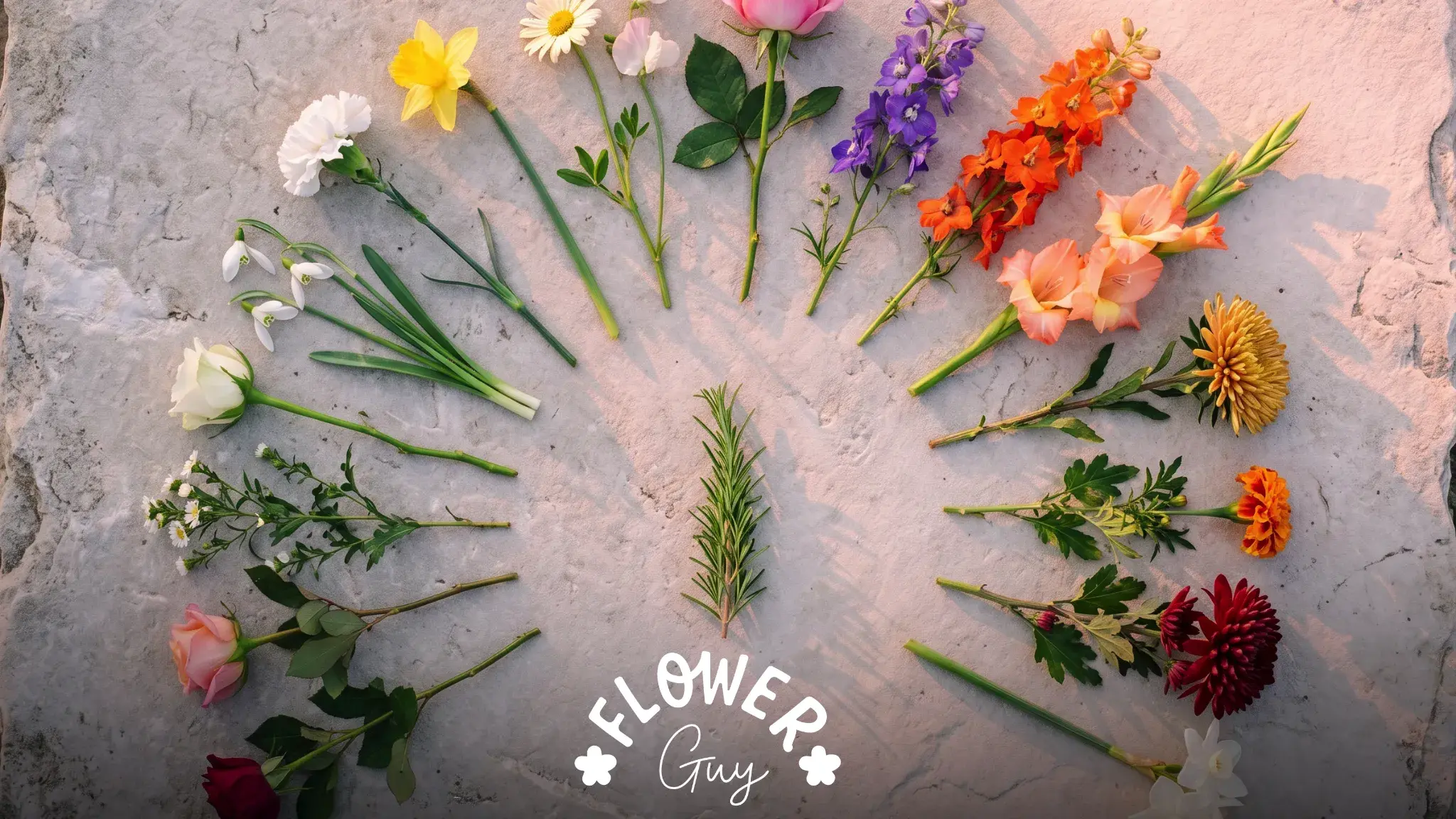
Birth Month Flowers: The Right Flower for Every Month
Every month has an official birth flower, and most have two. Here is the South African and Commonwealth-aligned list, which is the version you want for any birthday-flower-gift moment.
January, Carnation and Snowdrop. Carnations mean love and admiration. Snowdrops mean hope and the very first signs of spring.
February, Violet and Iris (or Primrose). Violets mean modesty and loyalty. Iris means faith, wisdom, and courage. Primrose means young love.
March, Daffodil and Jonquil. Daffodils mean rebirth, new beginnings, and unrequited love (the latter only in old floriography).
April, Daisy and Sweet Pea. Daisies mean innocence and loyal love. Sweet peas mean blissful pleasure and goodbye.
May, Lily of the Valley and Hawthorn. Lily of the valley means humility, sweetness, and a return to happiness. Hawthorn means hope.
June, Rose and Honeysuckle. Roses mean love (read the colour-by-colour breakdown above). Honeysuckle means devotion and bonds of love.
July, Larkspur and Water Lily. Larkspur means strong attachment and an open heart. Water lily means purity and majesty.
August, Gladiolus and Poppy. Gladiolus means strength of character, integrity, and remembrance. Poppy means imagination and consolation.
September, Aster and Morning Glory. Aster means love, faith, and patience. Morning glory means affection.
October, Marigold and Cosmos. Marigold means warmth, creativity, and powerful emotion. Cosmos means harmony and tranquillity.
November, Chrysanthemum. In South Africa and the United States, chrysanthemums mean joy, friendship, and longevity. (Skip them for European recipients, see notes above.)
December, Narcissus, Holly and Poinsettia. Narcissus means self-love and rebirth. Holly means defence and protection. Poinsettia means good cheer and success.
If you are buying a birthday gift, pairing the recipient's birth flower with their favourite colour is a thoughtful move. Pair with our Birthday Flowers, Birthday Flowers for Her, or Happy Birthday Flowers collections, and read our companion piece on happy birthday messages for the words to go with the bouquet.
Flowers for Every Feeling: Love, Friendship, Sympathy, Congratulations and Sorry
This is the practical section. If you are stuck on what to send, find the feeling, pick from the list.
For romantic love: Red roses (long-stemmed, classic), red tulips (a softer declaration), peonies (engagement-and-anniversary energy), or a mixed grand-gesture bouquet from our Romantic Flowers for Her and Grand Gesture Flowers collections.
For friendship: Yellow roses, sunflowers, daisies, or a colourful mixed bouquet. The Just Because Gifts collection is built for this.
For I appreciate you and gratitude: Pink roses, peach roses, peonies, or pink hydrangea. The Thank You Gifts collection covers it.
For new beginnings (move, graduation, new job, new chapter): White flowers, daffodils, strelitzia, or a fresh mixed bouquet. The Graduation Flowers, Housewarming Gifts, and Farewell Gifts collections cover the bases.
For congratulations: Yellow or orange roses, sunflowers, gerberas, or a celebration mix. The Congratulations Flowers collection works.
For sympathy and grief: White lilies, white roses, white chrysanthemums, soft pink gladioli, or a quiet white-and-green arrangement. The Sympathy Flowers and Funeral Flowers collections are built for this.
For I'm sorry: White tulips (forgiveness), white roses, hyacinth (the Greek myth attaches it to remorse), or a gentle pink bouquet. Avoid red roses for an apology (they read as romantic, not regretful). Avoid yellow carnations (old language: disappointment).
For get well soon: Sunflowers, yellow or pink roses, daisies, peace lilies, lavender. See the healing flowers section above. The Get Well Soon Gifts collection lives here.
For Mother's Day or Mom in general: Pink carnations (the original Mother's Day flower), pink roses, peonies, or her favourite flower full stop. The Mother's Day Flowers and Gifts for Mom collections cover it. Pair with our blog post on happy Mother's Day messages for the right words.
For just because: Anything that makes them smile. The whole point of just because is that it does not need a reason, which is exactly why it lands hardest. The Just Because Gifts collection covers it. Honestly, nearly every sentiment can be carried by the right just because bouquet, since the gesture itself is the message.
Negative Flower Meanings: The Ones to Be Careful With
Most flowers carry positive meanings. A few do not, and Victorian floriography was particular about this. Modern usage has softened most of these, but if you are sending flowers cross-culturally or to someone who knows their floriography, here are the ones to handle with care.
Yellow carnations historically meant rejection or disappointment. Avoid them in a romantic apology.
Striped carnations meant a clear no, I cannot be with you in Victorian language. Specific. Brutal.
Marigolds carry mourning meanings in some cultures, particularly in Mexico (Day of the Dead) and parts of South America. In South Africa they read as celebratory and warm.
Chrysanthemums are funerary in much of Europe (France, Italy, Belgium, Poland). Joyful in South Africa, the United States, and the United Kingdom. Check before sending to expat European recipients.
Lilies in some cultures, particularly in parts of Asia, are exclusively funerary. In South Africa they cross over comfortably between joyful and sympathy contexts.
Black flowers (very rare in nature, mostly very dark purple varieties or dyed flowers) carry meanings of farewell, mourning, or rebellion depending on context. Send only if intentional.
A bouquet handed upside down in Victorian language reverses the meaning entirely. Modern florists do not do this, but if a recipient ever turns their flowers upside down on you, take it personally.
If you are not sure about a recipient's cultural context, lean on roses, sunflowers, and proteas. They cross every border cleanly and carry nearly every sentiment between cultures without offence.
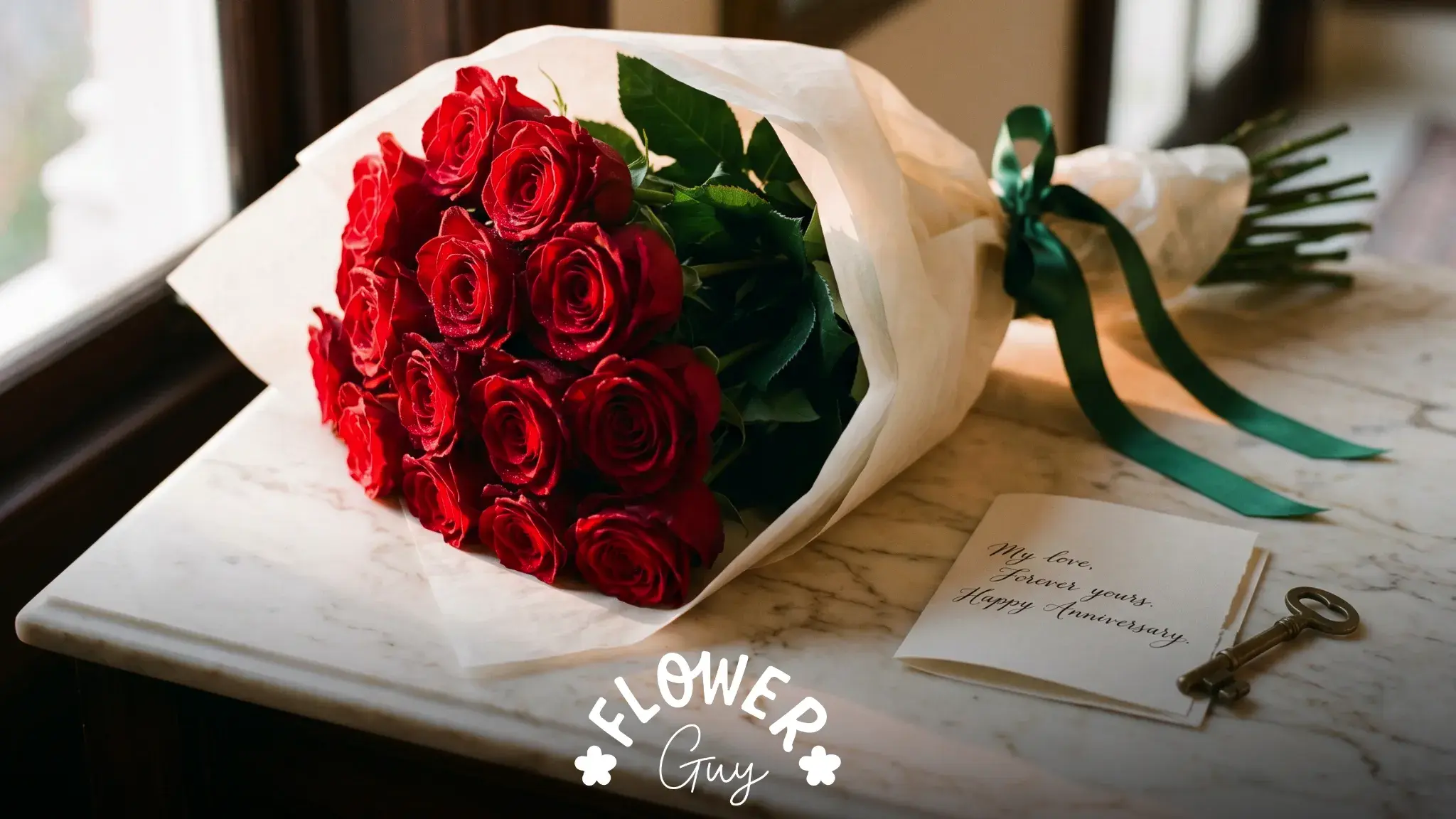
The Number of Flowers in a Bouquet (and What Each Number Means)
The number of flowers in a bouquet carries its own coded meaning, especially in red rose tradition. This is a piece of floriography most people miss, and it is one of the more romantic hidden meanings in the language of flowers. Sending a specific number of flowers turns a bouquet into a sentence.
One flower means love at first sight. A single red rose is the simplest, oldest declaration in the floriography handbook.
Three flowers mean I love you. A bouquet of three red roses is the classic three-word declaration without saying the words.
Six flowers mean I miss you, or I want to be yours.
Nine flowers mean together forever.
Twelve flowers symbolise a whole year, so they can mean loving you every month. Twelve red roses are the most common Valentine's Day bouquet for exactly this reason. Sending twelve roses says you are my everything, every day, every hour, every month of the year. The twelve also echoes the twelve months, the twelve zodiac signs, and the twelve hours on a clock, which adds a sense of cyclical completeness and harmony.
Sixteen flowers mean I wish you happiness. Often given to a friend or family member.
Nineteen flowers mean be together all your life, customary for a wedding gift.
Twenty-one flowers mean I am committed to you.
Twenty-four flowers mean I am yours every hour of the day.
Thirty-six flowers mean I will remember our romantic moments forever.
Fifty flowers mean unconditional love, no regrets. The 50 Roses Bouquet is built for this gesture and remains one of the most-sent grand-gesture bouquets in South Africa.
Ninety-nine flowers mean I will love you for as long as I live. (One hundred flowers, by superstition, is one too many and reads as overwhelming, so floriography stops at 99.)
One hundred and eight flowers mean will you marry me, in old Chinese flower-giving tradition.
For a long marriage anniversary or a grand-gesture-and-then-some moment, the number of flowers becomes its own quiet message. Most people will not know the exact code, but the recipient will feel the intention. Pair the number with the right flower and you have built a bouquet that says something specific without you ever having to explain it. The Grand Gesture Flowers and Statement Bouquets collections give you the right canvas for these larger numbered bouquets.
Flower Symbolism Across Special Occasions: Weddings, Funerals, Birthdays and Beyond
Flower symbolism shifts with the occasion, and choosing the right specific flower for the moment matters as much as choosing the right person to give it to. The same beautiful flower that lights up a birthday can feel out of place at a funeral, and the same gorgeous flower that suits an anniversary can read as too intense for a casual thinking of you.
For weddings, the symbolism leans toward pure love, eternal love, fertility, and a happy life. White roses, peonies, calla lilies, orange blossom, lily of the valley, and gardenia are the traditional Western choices. South African couples increasingly add proteas, strelitzia, and pincushion to their wedding bouquets to bring local meaning into the day. Wedding flower symbolism almost always centres on white, pale pink, soft cream, and green, with statement colours added for accent rather than dominance.
For funerals and sympathy, the symbolism leans toward peace, restful sleep, eternal sleep, remembrance, and the journey of the soul. White lilies, white roses, white chrysanthemums, gladioli, and forget-me-nots all carry these meanings. Lilies in particular are popular sympathy flowers, symbolising purity and innocence, and are often chosen for funeral arrangements to convey condolences. The Sympathy Flowers and Funeral Flowers collections respect these conventions.
For birthdays, the symbolism is open to nearly every sentiment, since a birthday gift can be friendly, romantic, family-focused, or celebratory. Birth flowers are the most thoughtful traditional choice (see the birth month flower section above). Otherwise, lean to the recipient's favourite colour and pick a flower that carries the kind of love or appreciation you want to express. Pair with the Birthday Flowers collection or any of our birthday-specific ranges.
For anniversaries, traditional Western symbolism attaches a specific flower to each year of marriage. Year one is carnation. Year five is daisy. Year ten is daffodil. Year twelve is peony. Year fifteen is rose. Year twenty-five (silver anniversary) is iris. Year fifty (gold) is yellow rose. The further into the marriage, the more the flower meanings lean toward enduring love, undying devotion, and the kind of partnership that has survived the years.
For Mother's Day, the traditional flower is the pink carnation, attached to a mother's love that does not waver. Pink roses, peonies, and a mother's actual favourite flower are all reliable choices. Pair with our Mother's Day Flowers or Gifts for Mom collections, and read our companion piece on happy Mother's Day messages for the right card to go with the bouquet.
For Valentine's Day, the symbolism leans heavily romantic. Red roses dominate. Pink and white roses lean softer. Tulips and peonies are the second-tier classics. Avoid yellow flowers (friendship reads wrong on a romantic occasion) and avoid chrysanthemums (cultural mismatch).
For graduations, new jobs, and milestones, the symbolism centres on new beginnings, success, and celebration. Daffodils, irises, sunflowers, and orange or yellow roses all carry the right energy. The Graduation Flowers collection sits in this territory.
For just because moments, the symbolism does not need to mean anything specific. The whole point of just because is that nearly every flower works, because the gesture itself is the message. The Just Because Gifts collection covers it.
South African Flowers Beyond Protea: Xhosa, Zulu and Cape Indigenous Symbolism
The protea section above covers the headline indigenous flowers, but South Africa's flower meanings reach further than the national bloom. Xhosa, Zulu, Sotho, and Cape Coloured traditions all carry their own flower lore, and a guide that calls itself complete needs to acknowledge it.
The aloe holds meaning across multiple South African traditions: protection, healing, strength, and resilience. The aloe flowers in winter when most other plants pause, which has tied it to perseverance through hard seasons. In Zulu and Xhosa medicinal traditions, aloe is also a healing plant, and giving aloe to someone going through illness carries a meaning of I am here, you will recover.
The clivia (bush lily, umayime in Zulu) is one of the most beloved indigenous garden flowers in South Africa. It means standing strong, family roots, and the patience of a plant that takes years to flower. Clivias are often passed down between generations.
The agapanthus (lily of the Nile, isicakathi in Xhosa) means love letters in some traditions, faith in others, and a quiet beauty in most. The blue agapanthus is the more spiritual of the two, the white agapanthus the more wedding-traditional.
The wild iris (Dietes) carries meanings of faith, hope, and a calm wisdom that grows wild across the Cape.
The amaryllis (Brunsvigia, the candelabra lily, sometimes called belladonna or beautiful lady) means pride, beauty, and sudden brilliance, since the flower bursts into bloom dramatically and briefly. The beautiful lady nickname (belladonna in Latin) comes from the Victorian language and is one of the older South African garden flower names still in use. Calling a flower a beautiful lady was a common Victorian practice, applied to several blooms whose form felt feminine, refined, or aristocratic.
The arum lily, our wild calla, means resurrection, magnificent beauty, and a quiet purity.
The flame lily (Gloriosa superba) means glory, splendour, and pride. It is also the national flower of Zimbabwe and carries strong regional symbolism across Southern Africa.
These flowers do not show up in imported floriography handbooks, but they carry as much meaning as any rose. If you are sending flowers to someone with deep South African roots, blending indigenous flowers into a bouquet is one of the most thoughtful gifts you can build. The Designer Bouquets and Statement Bouquets collections often feature these blooms when the season allows.
Long Vase Life: Which Cut Flowers Last Longest
If you want flowers that hold their beauty for as long as possible, the species you choose matters far more than the price. Some flowers fade in three days. Some flowers, with the right care, last three weeks. Long vase life is a practical consideration that often gets ignored when people focus only on flower meanings, but it affects how a gift is remembered.
Chrysanthemums can last two to three weeks in a vase. They are one of the longest-lasting cut flowers in the world, which is partly why they carry meanings of longevity in Asian cultures.
Carnations last seven to fourteen days. They were once dismissed as cheap filler, but the modern carnation revival has put them back in floral arrangements as a worthy main flower.
Alstroemeria (Peruvian lily) lasts up to two weeks. The flowers carry meanings of friendship, devotion, and mutual support.
Proteas last ten to fourteen days fresh and dry beautifully afterwards. The protea actually transforms into a dried floral arrangement that can last years.
Calla lilies last seven to ten days with proper care. The clean architectural shape holds even as the flower ages.
Roses last five to seven days, which is shorter than people expect. The trick is changing the water every two days and trimming the stems at an angle.
Tulips last five to seven days but continue growing in the vase, which is part of their charm.
Lilies last seven to fourteen days, with each bud opening over time so the bouquet feels like it is unfolding.
Sunflowers last six to twelve days depending on the variety.
Hydrangeas are the diva of the cut flower world: gorgeous when fresh, prone to wilting if they miss a single water change, but recoverable by submerging the entire flower head in cool water for an hour.
When in doubt for a long vase life arrangement, ask for proteas, chrysanthemums, alstroemeria, or calla lilies. They will carry your message for far longer than the average bouquet, which matters when you are sending flowers to someone going through a hard time who would benefit from beauty in the room for as long as possible.
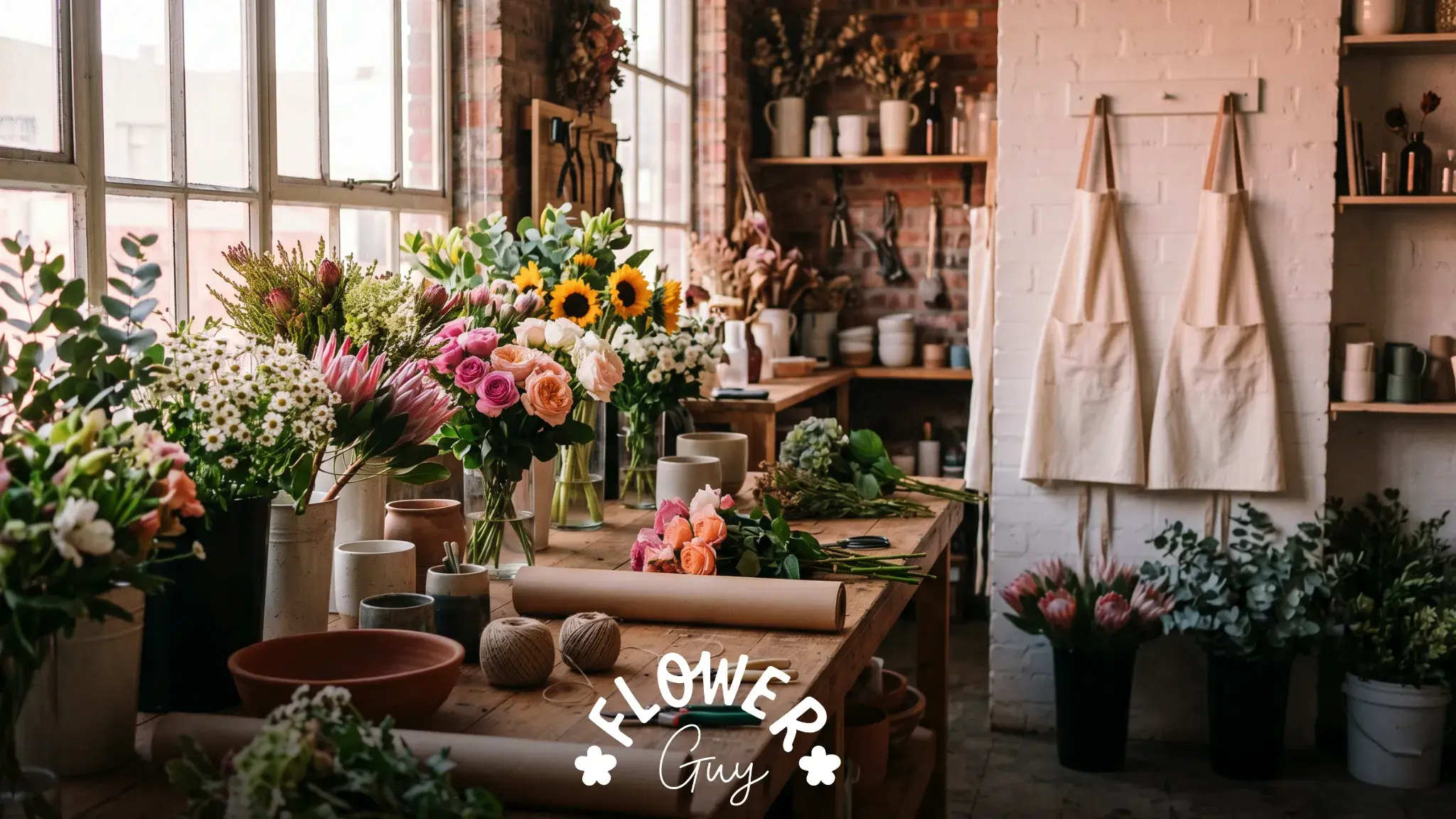
How to Choose Flowers When You Don't Speak the Language
Most people walk into flower buying feeling slightly lost. They have a feeling they want to express, a person in mind, and no idea which flower says it. That is fine. That is normal. Giving flowers should not feel like a test, even though many flowers carry hidden meanings and slightly different meanings depending on culture and colour. We have been doing this since the Victorians and still half of us google what flowers mean I love you on the way home. Giving flowers thoughtfully matters more than getting every meaning technically right.
Here is the shortcut.
Start with the feeling, not the flower. What do I want this to say? Pick from the list above. Who is it for? Their favourite colour usually wins. What's the occasion? Match a collection. Done.
If the feeling is big and the moment matters, pick a flower that lasts (roses, lilies, proteas, sunflowers) over one that fades fast. If the moment is light and small, almost anything works.
If the recipient is in Cape Town or Johannesburg, you can send fresh flowers same-day by ordering before 12pm Monday to Saturday (no Sunday delivery). If they are anywhere else in South Africa, our gift boxes ship nationwide within 2 to 4 business days, with non-perishable luxuries like chocolates, biltong, and wine that work just as well as a gesture. The Same-Day Flower Delivery collection covers fresh, and the Luxury Gift Boxes and Snack and Gift Hampers collections cover further-afield gifting.
The truth is most people remember how the flowers made them feel, not whether the meanings were technically correct. Pick something thoughtful, send it on time, write a real note. That covers more ground than any floriography handbook ever did.
If you want a starting point, our Cape Town flower bouquets and Johannesburg flower delivery pages show what we deliver same-day across the metros, and the full Shop Flower Guy collection lists everything we make.
Frequently Asked Questions About Flower Meanings
What flowers symbolize what?
Every flower has a meaning shaped by colour, species, and culture. Roses symbolise love (red), friendship (yellow), purity (white), gratitude (pink). Lilies symbolise purity and renewal. Sunflowers symbolise loyalty and adoration. Tulips symbolise perfect love. Peonies symbolise prosperity and romance. Proteas, our national flower, symbolise change, courage, and resilience. The colour and the species both carry meaning, and the strongest gestures pair them on purpose.
What flowers have the strongest meanings?
Red roses have the strongest, most universally recognised meaning of any flower: deep romantic love. After that, white lilies (purity, sympathy, renewal), sunflowers (loyalty, adoration), proteas (resilience, change, courage), and chrysanthemums (joy or mourning, depending on culture) carry the most weight. These are flowers where colour and species both signal strongly, which is what makes their meanings hard to mistake.
What do flower symbols mean?
Flower symbols, whether written, tattooed, or used in art and language, carry the same meanings as the live flowers they represent. A rose symbol means love. A lily symbol means purity or sympathy. A lotus symbol means rebirth and spiritual awakening. A protea symbol, particularly the king protea on South Africa's coat of arms, means leadership and beauty. The 🌹 emoji, the 🌷 emoji, and the 🌻 emoji carry the same casual meaning weight as their physical equivalents.
What's the birth flower for each month?
The official monthly birth flowers are: January (carnation, snowdrop), February (violet, iris, primrose), March (daffodil, jonquil), April (daisy, sweet pea), May (lily of the valley, hawthorn), June (rose, honeysuckle), July (larkspur, water lily), August (gladiolus, poppy), September (aster, morning glory), October (marigold, cosmos), November (chrysanthemum), December (narcissus, holly, poinsettia). Pairing somebody's birth flower with a thoughtful note is one of the more underrated birthday moves.
What flower means "I love you" without saying it?
A single red rose says it most clearly. A dozen red roses says you really mean it. A red tulip says it more softly. A peony says it for an anniversary or engagement. A bouquet of mixed red and white roses says it has lasted. If you want to say I love you without the words, send red. The colour does the work.
Are there flowers I should avoid sending?
A few, depending on the recipient. Avoid yellow carnations and striped carnations for romantic gestures (Victorian meanings: disappointment, rejection). Avoid chrysanthemums for European recipients in France, Italy, Belgium, or Poland (funerary). Avoid red roses for apologies (they read as romantic, not regretful). Avoid lilies for parts of Asia where they are exclusively funerary. When in doubt, send roses, sunflowers, or proteas. They cross every border cleanly.
What does each colour of flower mean?
Red means love and passion. Pink means affection and gratitude. White means purity, peace, and sympathy. Yellow means friendship and joy. Orange means enthusiasm and warmth. Purple means royalty, dignity, and admiration. Blue means serenity and trust. Mixed colours mean abundance and full-spectrum joy. Pair the colour with the species for a layered message.
Which flowers symbolize healing?
White roses, yellow roses, sunflowers, peace lilies, daisies, chamomile, lavender, and eucalyptus all symbolise healing, comfort, and recovery. They feature heavily in get-well-soon bouquets and convalescence gestures because their meanings centre on peace, patience, restoration, and unwavering support. Our Get Well Soon Gifts collection is built around these blooms.
What flower means "thank you"?
Pink roses are the most direct thank you flower. Peach roses, pink hydrangea, and peonies also signal gratitude, with peach leaning sincere and grown-up, hydrangea leaning emotional, and peonies leaning a little luxurious. For a smaller everyday thank-you, sunflowers and yellow roses also work as friendly gestures of appreciation.
Which flowers say "I'm sorry"?
White tulips are the clearest I'm sorry flower (Victorian meaning: forgiveness, fresh start). White roses signal a sincere apology and a wish to start clean. Hyacinth, attached to a Greek myth of regret, also carries this meaning. Avoid red roses for apologies (they read as romance), and avoid yellow carnations (old language: disappointment).
What is South Africa's national flower and what does it mean?
The king protea (Protea cynaroides) is South Africa's national flower. It means change, transformation, courage, beauty, and diversity. Named after the Greek god Proteus, who could shift form at will, the protea regenerates after wildfires and outlasts almost every other flower in a vase. It features on our coat of arms and in our Protea Bouquet collection. Sending a protea is a uniquely South African gesture that says you are remarkable and resilient, and it carries cultural weight no imported flower can match.
Which flower has the most diverse meanings?
Roses carry the most diverse flower meanings of any single species, with different colours expressing passionate love (red), pure love (white), sweet love (pink), friendship (yellow), enthusiasm (orange), and enchantment (lavender). Chrysanthemums are also among the most diverse flowers, since they swing entirely from joyful (in South Africa, the United States, and Asia) to funereal (in much of Europe). Tulips and lilies also carry multiple meanings depending on colour and species. The most diverse flowers tend to be the ones with long-cultivated varieties and rich histories across many cultures.
What does it mean to send withered flowers?
In Victorian flower language, withered flowers reversed the meaning of the bloom entirely. A withered red rose meant the love is over. A wilted bouquet was a polite way to break off a courtship without ever saying the words. Modern floriography rarely uses this convention, and most withered flowers today simply mean the bouquet has aged. If you receive a wilted bouquet from somebody who knows their floriography, however, it might be worth a careful conversation.
What flowers mean "absent friends" or remembrance?
Several flowers carry meanings of remembrance and absent friends. Forget-me-nots are the most direct (the name is a translation of the German Vergissmeinnicht, used by lovers and parted soldiers for centuries). Rosemary means remembrance in old English tradition (Shakespeare's Hamlet gives Ophelia the line there's rosemary, that's for remembrance). Zinnias mean thoughts of absent friends. Heather is a flower of remembrance in Scottish tradition. Poppies, especially red poppies, are the flower of remembrance for fallen soldiers in Commonwealth countries, including South Africa, where they are worn on Remembrance Day each November.
Which flowers symbolise eternal love and undying love?
Orange blossom is the classic eternal love flower, the bridal bloom of Queen Victoria and the symbol of a happy life and lasting marriage. Red roses symbolise passionate love and undying love that remains alive. Peonies mean a happy marriage and the kind of love that grows richer over time. Forget-me-nots mean true love, remembrance, and a love that does not fade with absence. Ivy symbolises fidelity and a love that holds on. Sending any combination of these in a bouquet to a long-term partner says this is built to last.
What is the most popular flower for thoughtful gifts?
Roses remain the most popular flower for thoughtful gifts globally, mostly because their meanings are universally understood and the colour range gives you so much room to fine-tune the message. After roses, sunflowers are the second most popular for thoughtful gifts, particularly for friendship, support, and thinking of you gestures. Tulips, peonies, and lilies all sit close behind. For South African recipients, proteas and other indigenous flowers carry meanings that no imported bloom can match, which makes them an exceptionally thoughtful gift for someone with a sense of home.
What flower means "I love you" without saying it?
A red rose says it most clearly. Red roses symbolise love and desire, and a single red rose has signalled love at first sight in floriography for centuries. White roses symbolise purity and a fresh start. Pink roses signal admiration and gratitude. If you want to say I love you without the words, send red roses. Three red roses traditionally mean I love you directly. Twelve red roses mean I love you, every day, every month of the year. Fifty roses say it loudly. Pair with the Romantic Red Roses Bouquet or Red Rose Bouquet collection.
What plant or flower says "sorry"?
White carnations are the classic apology flower. They symbolise sincere intentions, pure love, and a desire for a fresh start, which is why they are sometimes called forgive me flowers. White tulips are the second classic apology flower (Victorian meaning: forgiveness). Hyacinths, attached to a Greek myth of regret, also carry an apology meaning. White roses symbolise a sincere apology and a wish to start clean. Avoid red roses for apologies (they read as romantic, not regretful) and yellow carnations (old language: disappointment).
What does a black rose mean?
A black rose is technically a very deep velvety burgundy or dark maroon, since true jet black roses do not exist in nature. The most popular black rose is the Black Baccara. A black rose carries meanings of mysterious love, deep passion, mourning, farewell, and a love that exists outside the ordinary. In modern wedding and statement bouquets, black roses lean toward elegance, drama, and a counterculture energy. In sympathy and mourning bouquets, they lean toward acknowledgement of a heavy loss. In romantic gifting, a single black rose can mean I see you, I am drawn to you, you are not like anyone else. Always send black roses with intention; they are not a casual flower.
What flowers symbolise death and mourning?
White lilies, white chrysanthemums (in European tradition), white roses, dark red roses, gladioli, and forget-me-nots all symbolise death, mourning, eternal sleep, and remembrance. Poppies, especially red poppies, symbolise restful sleep and remembrance for the fallen, particularly soldiers. Marigolds carry mourning meanings in Mexico's Day of the Dead. Cypress and yew, while not flowering, traditionally accompany mourning floral arrangements. The colour for funeral flowers is usually white, soft pink, deep purple, or the recipient's favourite colour.
Which flower represents strength and resilience?
Several flowers represent strength and resilience, with meanings rooted in how the plant grows. Proteas are the headline strength flower, regenerating after wildfires and outlasting almost every other bloom. Sunflowers mean unwavering loyalty and the strength to keep facing the light. Gladioli mean strength of character and integrity (the name comes from the Latin gladius, meaning sword, because of the leaf shape). Snapdragons mean grace under pressure and inner strength. Aloes mean healing and resilience. Pincushion proteas mean courage in the face of difficulty. For someone going through a hard time, any of these flowers carries the right meaning. Pair with the Protea Bouquet or Sunflower Bouquet collections.
What is the most powerful spiritual flower?
The lotus is widely considered the most powerful spiritual flower in the world. It is sacred in Hinduism and Buddhism, representing the journey of the soul toward spiritual awakening. It grows from muddy water and emerges spotless, which became the metaphor for enlightenment rising from the mess of human existence. Different lotus colours carry different spiritual meanings: white for spiritual perfection, pink for the supreme lotus of the Buddha, red for the heart and pure love, blue for wisdom, purple for the mystical path. After the lotus, the rose, the lily, and the chrysanthemum are the most spiritually weighted flowers across global traditions.
What flower calms anxiety or symbolises calm?
Lavender symbolises calm, restful sleep, and recovery from anxiety or stress, and the actual scent of lavender has measurable calming effects. Chamomile symbolises patience and gentle restorative care. Peace lilies symbolise tranquillity and a quiet space to heal. White flowers in general symbolise peace. Lotus flowers symbolise spiritual calm. Cosmos symbolise harmony and tranquillity. For somebody having a hard mental-health stretch, sending a calming flower carries a real meaning and a small practical benefit at the same time.
What does a flower bouquet emoji mean?
The 💐 (flower bouquet) emoji generally means a gift of flowers, a celebration, a thank you, or a romantic gesture. The 🌹 (red rose) emoji specifically means love and romance. The 🌷 (tulip) emoji means a gentler romance, friendship, or a celebration of spring. The 🌻 (sunflower) emoji means warmth, friendship, and thinking of you. The 🌸 (cherry blossom) emoji is most often used to represent the spring season, since cherry blossom is at its best in spring. The 🌺 (hibiscus) emoji means tropical beauty, exotic warmth, and a fun, sunny gesture. The 🌼 (daisy) emoji means innocence, cheerfulness, and a gentle hello. Emoji flowers carry the same casual meaning weight as their physical equivalents, just smaller and more digital.
What flowers mean welcome and new beginnings?
White flowers in general signal new beginnings (white roses, white tulips, white lilies). Daffodils, the March birth flower, mean rebirth. Strelitzia (bird of paradise) means freedom and a new chapter. Sunflowers welcome warmly. For a housewarming, the Housewarming Gifts collection is built around exactly this energy. For a welcome home, a fresh mixed bouquet from the Mixed Flower Bouquet collection or a Bouquet of Flowers does it.